
O3 Newtown – Side B: Study Space: The Game
v1.3.2 (24 Oct)• Noted in a hotfix of v3 that gacha rates are now stated to a decimal place, confirming optimal yield times for 3☆/4☆ Oysters. When a 4☆ shows up again, I’ll get back to you on those numbers.
To Do
•
v2.0 (21 Oct): v3 of the app has been released• New subscription pricing to be reflected in side A
•
v1.4: Possible improvement to this system to improve retention• Perception of rates: People seem to underestimate the odds of certain percentages, whose ‘feel’ is sensed through experience
past updates
v1.3.1(21 Aug): Fixed hyperlinks, updated 4☆ gacha rates in the August 18 update, and added reasons to not throw a study sessionv1.2(21 Aug): Reworded overtime section and added a table to help determine when it’s worth getting casual top-ups over a subscription; rephrased a few sections for disambiguation and clarificationv1.1(19 Aug): The 18 August update introduced a new subscription system, so I’ve provided a bit of extra comment around that. The coloured system part stays in its entirety to provide context.v1.0(17 Aug): First complete edit and attempt at a publish. Lots of rearranging, shortening (😩), and rewording to do. Better something than nothing!v0.4(12 Aug): Content revision.
Target market: Who it’s not for
Subscription tiers: Reasonings for each
Overtime rules and casual rates
Scanning in and out
Food: Policies and its reasons
A possible overlooked rule for a 24/7 café in Newtown
App features:
• Gacha: Rates
• Chat: Has meowing gone too far?
• O-coins: Usage meta
• Profiles
Seating: Something suitable for everyone
Suitability for me:
• Looking at it in layers
• Me vs others who need it more
• Compared to work: Choosing here over there
• Charting and gaming: What am I getting out of O3?
When I do remember, I’ll update this post as it comes. Hopefully with more photos too whilst I’m at it.
In my previous side A article on O3’s recently opened, student-centric study/coworking café in Sydney’s Inner West (and City of Sydney) suburb of Newtown, I talked about my impressions with the companion app and how those three complimentary hours in the venue went, blissfully unaware of the supposed tidal wave that was O3’s viral influence, or any other associated news.
Now, my student days were a thing of the yester…decade. But it’s my prior experience at a coworking office that’s what piques my curiosity about this coworking space.[1]
I must confess I initially intended to approach this place as just a meme, showing up reciprocating that energy as “that one guy who literally rocked up to <unexpected place> with a DDR travel pad” for shits and giggles.
However, putting on my freelancer hat, I did want to actually test the viability of working there. Evidently, my response to “how’d you find the spot” that was supposed to have easily fit into a 2000-character Discord message instead spiralled into a 16k-word essay. Oops 🤭
But hey, with O3 propositioning an interesting concept (both the app and especially its pricing model), how could you expect me out of all people to leave such a place without a whole lot of thoughts?
v1.0: I’ve received feedback that both side A and this does feel like I’m downplaying elements of the ecosystem and critically emphasising bias on revenue generation. Sure, but I would be lying if I tried to say a gacha system isn’t revenue generating at heart.In the interest of others who are new to RNG mechanics (and especially the budget-conscious student), I feel like it’s in my best interest to provide insight into exactly what they’re signing up for. As the blurb says, it’s a strategy guide!
And so, behold: the following are my said thoughts.
Target Market
If you read the CEO’s story and vision for O3, you know, that they know, who they’re pitching their services to: students.
Having established that, it’s apparent why the decisions on certain aspects were made as such.
What aesthetic trends would I think appeal to the HSC/university grinders of the 2020s? Keywords or things might include lo-fi art, wabi-sabi, biophilic spaces, “Ghibli”,[2] and photogenic Instagram-worthy food.[3] Has O3 nailed these themes in Newtown? If the news articles and search results speak for themselves, then yes, definitely.
How do students (well, anybody, really) of our age interact these days with the environment and others? Digitally, of course. To not attempt to incorporate this into an ecosystem would be creating friction for a vast majority of people where apps, social media, and online banking are second nature to them.
The only exception to where such things are instead a cause of friction are those who are not in that majority – mainly by manner of situation, but also occasionally by deliberate choice.[4]
And if we’re going digital, then why not tap into games, yet another concept that should honestly be no stranger to anyone these days?
The price range is, by necessity, on the extreme lower end of offerings from the various available coworking options. I’m well aware I’m saying this from a privileged standpoint as someone who’s done a few gigs in the private sector – which for a fair number of students, and basically every high schooler save for some exceptions, isn’t relatable.[5]
(Possible) incompatibilities
But in saying that, consequentially, we know who O3 may not be for. In order of most incompatibility to least:
- Outright filtered: Those who are less literate with digital platforms and/or its ecosystem, or those who choose not to be involved with it.
- If you don’t have a smartphone or know how to navigate the required app, you can’t enter.
- If you don’t have an email, you can’t sign up. (Nothing is stopping you from using a burner account, though.)
- Strong detractor: In the event of a worst-case scenario, those who are looking for an alternative, safer place to study in peace.
- Whilst the turnstiles filter out random people from entering, O3 specifically wants its members to (at least put some effort to) be social. I had a discussion about the premise with a few friends who generally agreed that there inevitably will be the 1% who either lack a sense of TPO (JP language), or those with more malicious intentions to abuse the social opportunity to treat the place as more of a mixer than a study space.
- Thankfully, in the context of the public group chat, behaviour like this is often ignored, called out, or reacted with appropriately. So far, Newtown’s community has been pretty good on this.

- Strong detractor: Those looking for a study space that’s better than a library or café but needs it to be permanently free.
- There are pros and cons for paid vs free study spaces. When you consider aspects like staffing, funding, maintenance, crowds, the point above, etc, you may appreciate the need for a paid space.
- Newtown reaches max capacity most of the time even when students are given three free hours a week.
- It might take some time for local governments to hop on the study space train so long as they’re able to differentiate between that and a library. The Tech Central Innovation Hub gets close, but like the name suggests, that is more SMB-centred and corporate than a chill place to study. Think Fishburners’ hub.
- Detractor: Those who see the social aspect of O3 as a gimmick.
- However, everything is optional; you don’t have to decorate or fill in your profile, look at the group chat ever (trust me, nothing… much goes on in there), or feel obliged to interact with other people at the venue.
- Many visitors are inclined, however, to mind their own business because they’re too busy to socialise – especially if they’re paying for their time there!
- Detractor: Those who don’t understand, or dislike, gamification.
- O3’s system and content have plenty of references to gaming culture: gacha mechanics, collect-’em-all, randomised value drops, alternative ways to gain O-coins (or even just the existence of them in general). These concepts may be immediately understandable to those who “get it”, but there are still many confused or unaware of how they work.
- Some may treat these features as initially superfluous but be overwhelmed in learning how to make the most use out of these systems, especially when they’re pressured to understand them due to the perks that they provide.
- Neutral: I’ll be honest here – older people.
- If you can tolerate “a bunch of kids” (relatively speaking) and their energy, that’s fine, so long as you don’t mind standing out. Besides, the matter shouldn’t be taken personally, and anyone – either side – who isn’t cool with that is kinda cringe.
- But! Café staff don’t deserve to take the brunt of a verbal altercation about the so-called inconvenience of going through hurdles that younger generations have absolutely no issue with.
- Neutral: People who are inclined to have, or need, dedicated desks.
- It’s not the space for you, and it won’t be any time soon because it’s contrary to O3’s mission, be it functionally or especially visually. (The CEO explicitly made the latter part clear in a few interviews.)
- On the other hand, those who are fine with giving dedicated desks up for hot-desking could find this space very appealing…
- Strong attractor: …Appealing to those such as freelancers, sole traders, remote workers, and the like.
- One of the scenarios I can likely see happening is that O3 eventually saturates with customers like me who think
$80$65 (!) a month is a no-brainer bargain steal for a place to hot-desk, provided they can compromise with the other above-mentioned points. - As paid members get priority entry, they will deny what I presume would be a sizeable portion of their intended customer base, which are students on the Free or Silver plan.
- As mentioned in my previous article (bookmark jump), O3 did float the idea of switching up their subscription plans to be appropriately priced for students and professionals. This may be the disincentive for professionals that the lower-paying students need to get an edge.
- One of the scenarios I can likely see happening is that O3 eventually saturates with customers like me who think
Suggestion: restricted hours
It would be a missed opportunity for O3 to not capitalise on professionals – after all, they’re the ones who will provide stability for the long term!
But as I alluded to in side A, there’s a balancing act to be had in keeping it fair for both parties. At the reservation of making things more complicated, which is something O3 wants to steer away from as evident in their legacy plans, one possible compromise would be to introduce peak hour restrictions.
We could make it, say, 14:00 – 19:00: about the time high school students would show up to when Opal off-peak finishes.[6]
High school students likely won’t be utilising the perks of 24-hour access (until they hit uni, whereupon they quickly learn all hours are fair game). As such, a hypothetical discounted Student plan could have its access restricted to staffed hours like how Free tier members do but get priority access during peak. Conversely, a member on a Professional plan could enjoy 24/7 access but only outside of peak, whether that be an outright entry bar or only just priority rights.
Yet, the introduction of a Student plan comes with ensuring a Student is a student = all that data collection/privacy stuff O3 must navigate. With an app, users can imply a scan and upload process, which a business (acting in complete sincerity) leverages to cut manual work and ensure compliance. But for a café that implicitly operates on an honour/trust system? Probably not necessary; an in-person check for a current valid student card and setting a yearly eligibility flag on their O3 account might suffice.
Sure, like any system that provides the affordance, people will always cheat no matter what. For example, my university ID doesn’t state a year, so it’s “valid” forever as long as I can maintain my appearance in the photo. But spare a moment for the under 18s who have a genuine fear of identity theft and don’t want to be triggered by yet another ID check…
Or maybe it’s not necessary after all
If students ask for value, sure, give it to them – but maybe not at the expense of higher maintenance costs and/or risk. Implementing a time-lock adds more room for errors.
Indeed, the current *options, especially the weekly or monthly plans, already fit the needs of a student, especially when there’s a clear establishment of on-off periods of teaching/breaks.
And let’s face it – as complex and appreciable as the existing gamification elements are, most don’t want to think of the subscription model as yet another thing to be gamed (as unfortunate as it is for me to hear) and end up with choice paralysis.
well, the students don’t lie – so best to ask!
Subscription Tiers
Moving over from hypotheticals to reality, let’s talk about O3’s current pricing plans, along with their former “coloured” plans, since this provides a lot of context as to why everything is priced as such.
Current pricing
Unlimited access to all O3 venues (in the event you visit Melbourne or NZ), even if the venue is at full capacity or when the café staff aren’t around. The difference is your commitment, which determines how often you’re charged.
| Schedule | Discount | Cost ($/wk) | Charged |
|---|---|---|---|
| Weekly | $20 | $20 | |
| Monthly | ($15 × 52) ÷ 12 = $65 | ||
| Semi-annually | ($10 × 52) ÷ 2 = $260 |
Former coloured plans
When I wrote this in early/mid August, there were three paid tiers, charged monthly (they state weekly rates to boost its appeal).[7] Here’s why I might choose to upgrade, or downgrade, to/from each tier.
| Tier | Cost ($/mo) | Perks | Why? |
|---|---|---|---|
| Free | $0 |
|
|
| Silver | $40 |
|
|
| Gold | $80 |
|
|
| Black | $200 |
|
|
Example: you’re on the Free plan, and you had 1:15 left. At weekly reset, your new time is not 4:15; it is 3:00.
The only difference between Gold and Black is that for an extra $30 a week, you get your entire $50 “refunded” in O-coins (Ø500, not $50). You can use them however you like, i.e.
- Spending on actual café items
- Rolling gacha for discount privileges so the café is cheaper in the long run
- Straight up giving them away in the live chat to auramaxx
- Save some for emergency overtime
A double-edged sword made of Silver
Oh, an equally important detail:
It’s like that so holidays, or perhaps a less busy week B (is that a thing across most high schools?) won’t mean you lose your 10 hours during those weeks that you’d have little reason to go. See the earlier point on how students have busier/quieter times in the year.
Additionally, as exceeding your hours is Not Good, you should allow a little bit of time for leeway. And, because a weekly allowance means you’ll be wasting four ‘a little bit of time’s instead of one, a monthly expiry actually works in your favour. More on this in just a bit.
Consequentially, it’s your responsibility to divvy that 40 up evenly across the month and not go into overtime. Otherwise, there’s a heavy penalty to pay…
Overtime Rules
Limited-time plans grant you allocated time to be in the venue. You start the timer the moment you scan in at the gates, placed across from the café counter,[8] and it halts when you scan out.
Should you allow the timer to run out, you will be in debt and must pay back your overtime with one-off hours that are sold at casual rates before you can scan back in again.
| Eq. Hours | |||||||
|---|---|---|---|---|---|---|---|
| Hours | $ | Ø | $/hr | Wk | Mo | ½ Yr | |
| Silver | 40 | $40 | — | $1.00 | |||
| Casual | 1 | $7.50 | Ø75 | $7.50 | 5:40 | 20:40 | 112:40 |
| Casual | 3 | $15 | Ø150 | $5.00 | 7:00 | 25:00 | 130:00 |
| Casual | 10 | $30 | Ø300 | $3.00 | 9:40 | 33:40 | 164:40 |
With the August 18 update reducing memberships to just the Gold plan (with commitment discounts), the question now is:
Yes: Purchase the subscription.
No: Purchase the casual hours.
Example: if you’re wondering whether to spend $15 on a top-up or $20 on the weekly subscription, the question is whether you think you’ll be spending more than seven hours in the next week. If so, you’re better off purchasing the subscription, because dollar-wise that’s how much $20 gets you at that casual rate (four paid hours after the free three). Except that you can only pay in multiples of $15, in which case you’d have to spend $30 – and so you might as well get the subscription for $20.
Another one: it’s uni holidays, and you’re tossing up between two $30 top-ups over the next month or the $65 monthly sub. At $3/hr, $65 is 21:40 + 12 free = 33:40. You think you will definitely be around for 25ish hours within the next month (at a roughly even rate where you will be using up the free hours each week). So, for this situation, paying the $60 for the excess 13 hours is better than forking out $65. Plus, you get to keep the remaining seven hours to use whenever you want!
So it’s in your utmost priority, and best interest, to never let the timer run out.
That means your three hours’ allowance (or ten, if Silver plan did divvy up the 40 that way) is actually more like that minus at least ten minutes. That’s what I mean by losing out on four bits of time versus one.
Why at least ten minutes? Say you’re on Silver, and during unstaffed hours you accidentally left your card case – in it your bank card, Opal, licence, all that – on a seat in the upper floor’s study room somewhere. You do not want to try and get that back with only 19 seconds left on the timer.
Don’t be that person. Please.
Scanning
Whilst we’re talking about scanning in or out and leaving enough time:
It would be a good idea to leave sufficient time to do a lap around the gates in the event the system didn’t correctly register your scan status.
If you scan too soon after the person ahead of you had walked through the gates, and now the doors have closed on you in confusion,[9] you can scan again without worrying what state you’re in.
Unlike Opal, which works on a toggle system (at least with the free-standing poles), this method is to protect both you and O3. Just like you don’t want to have scanned twice exiting and be outside with the timer still running, O3 shouldn’t let you do the opposite, scanning twice entering and being registered as scanned off when you’re actually inside.
Also, side note, I’m hoping the app was created in such a way as to ensure the scanning process remains secure and airtight. Otherwise, there might be a potential for people to start getting certain ideas…
If you forget to scan off, O3 Terms states it’s on you. If you must share it to prevent your hours getting drained, at least only give it to O3 staff, where one of them will usually be on premises 24/7.
Food
Outside store-bought food or beverages […] are not permitted within O3 premises. Home-prepared food may be consumed […] provided it does not create odour, mess, or hygiene issues, and is for personal use only.
O3, being a café, is required to follow food safety rules. Bringing outside food in from a different store only serves to complicate things when stuff like food poisoning or an anaphylaxis event occurs. How does one prove with certainty it wasn’t O3’s fault?
The part about allowing home cooked meals is to cater to an individual’s needs. If someone is intolerant to a variety of ingredients such that no food at the café is suitable, it wouldn’t be fair to let them starve because of that.
However, by allowing people to bring their own meals, O3 is taking on a considerate risk. Even if someone brings their own meals, food can still be exposed to an environment where allergens are spread around, be it airborne or trace amounts on surfaces.
Prime example? Shared microwaves, a facility available at other O3 venues. Not that I would ever want to use one in a communal environment.[10]
One Missing Rule?
If you read my side A article, you may remember me leaving you a thought about how O3’s Terms appeared to potentially overlook one particular thing.
One of the advantages of coworking spaces is that they are usually 24/7, and O3 is no different. And if you’ve ever been to an Internet café… I think you’ll understand what I’m getting at here.
At my old coworking spot, there was a strict no sleeping policy. Like, RSA strict; after all, they did have a drinks fridge. If you are seen lying down asleep at your desk or on the couch, you’ll be asked to go home.
I don’t know what O3’s stance is when it comes to this, but this kind of rule usually forms a part of a coworking space’s terms of use. And so, when I first read the Terms, with half anticipation yet also half concern, I didn’t see any mentioning of that in there.
Given that there is a beanbag-and-couch chill zone both at the back of the ground floor and in the nook, I can imagine there will be a few paying students coming in to use that area as a pseudo-hostel to all-nighter final-week procrastinate their 40% assignment.
Or, if you consider that Newtown is a popular spot for pub crawling, well, you can connect the dots.
For what it’s worth, after-hours access is via a solid door just to the left of the shutters that is the main entrance, so it’s not like the public can see what’s happening inside after the café closes.
I’ve read some people would love to see a 24/7 place adopt similar rules to Japanese Internet cafés where there are proper options to lodge. Though, again, whilst personally this would be incredible to see happening, O3 is at the hands of council/government regulations, and this place is certainly no lodging facility to them.
But honestly, I wouldn’t dare sleep in a place where a torii gate (and I guess the triple-eyed spirit guardian Tomo just in front of it) is witnessing your actions in this study ‘shrine’, shall we call it. If it demands respect, best to do it.
App Features
Gacha
A key feature of O3’s digital ecosystem is the gacha, where you can roll Oysters of various rarities to catch, just like Pokémon (last I checked there were 207 of them, and likely increasing as I speak).
Regardless of how it’s presented, the basic idea is that you roll some number. If it compares favourably to an Oyster with a certain value, you get it. If not, you don’t. That’s it.
Mhm. Wake up, it’s 2026. A gacha in a coworking space. Get with the times.
Earlier, I mentioned whaling or rolling for discount privileges (officially “Superpowers”) at the café. That’s what the 3☆ “Ultra-Rare” and “4☆” (shown as a platinum crown before the August 11 update) “Cosmic” rarity Oysters provide. Whilst at this point each Superpower is unknown and subject to change,[11] the tutorial primer on Oysters teases some of the benefits you can expect.
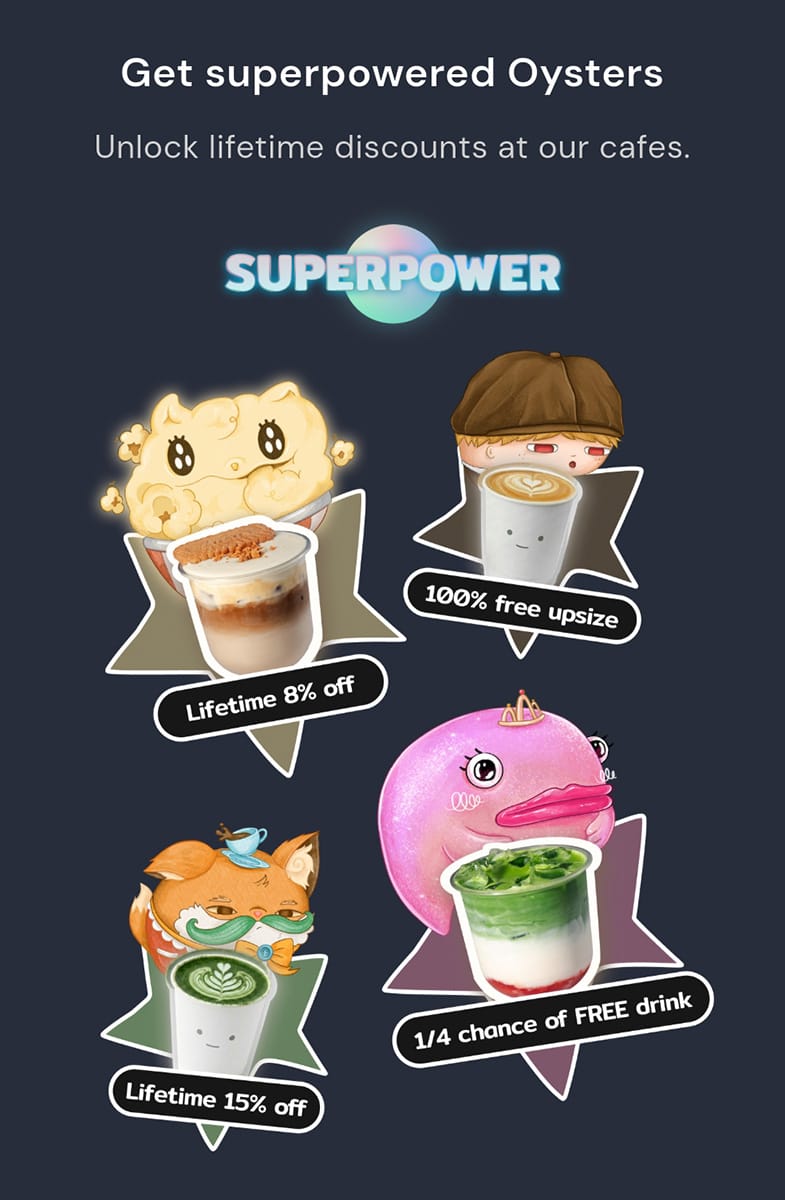
A permanent percentage off, upsize, or especially that 25% chance to get a free drink provide strong incentives to encourage spending.
And no, you can assume O3 hasn’t thought far enough to implement any complex systems such as pity mechanics for safeguards. I’ll leave that as an explanation for a footnote instead,[12] but in short, because ✨maths✨, “1 in 4 chance” does not imply you get the free drink after four purchases – or any number, for that matter. 1 in 4 is just the expected average, and as you know, things more often than not go out of expectations.
Amidst writing this article, the format of the gacha changed. Here’s what it was during the first week.
july 18 format
- Each day had a pool of six Oysters you could roll. 3☆ Oysters had a drop rate of around 7 to 12% – so from 12 to 20 times better than the golden standard. The 2s and 1s seem to be equally distributed. I’m not sure of the rate for a 4☆, but I wouldn’t be surprised if they had them closer to the true “limited banner rates”.
- You can only roll whilst you’re scanned in at the venue, and you get one chance for free. Further rolls cost Ø10… at least on the first roll. If we’re gonna talk gacha, we’re assuming all the tropes are being pulled out of the bag, successively increasing costs included.
- Rotating the daily pool is also possible for Ø10.
The July 25 update revamped the ruleset to what it is currently:
- You can now pull for Oysters outside the venue, incentivising study no matter where you are.
- Instead of from a select pool of six, it is now one completely random Oyster from the pool of all available ones, even those you already have.
- Reminiscent of apps like Forest, the gacha now implements a focus timer mechanic. You declare a set amount of time in the O3 app, from 10 minutes to three hours, to which your device is locked to the timer. No switching apps to something else! (Save for some exceptions.) Otherwise, apparently, your rate drops. The longer you set the timer, the higher the chances of catching the Oyster – albeit the rates not increasing linearly, with diminishing returns. The most optimal time for its rates, plus the maximum three-hour rate, is:
- 1☆: ~23.5%, 0:30 • 70%
- 2☆: ~16%, 0:30 • 40%
- 3☆: ~2.0%, 0:10 • 15%
- 4☆: ? • 7% (rounded)
- Adding friends to the current attempt increases the odds of success. I’m unsure of these rates as I don’t plan on figuring that out any time soon.
- 1☆: ?
- 2☆: +3%
- 3☆: +2%
- 4☆: ?
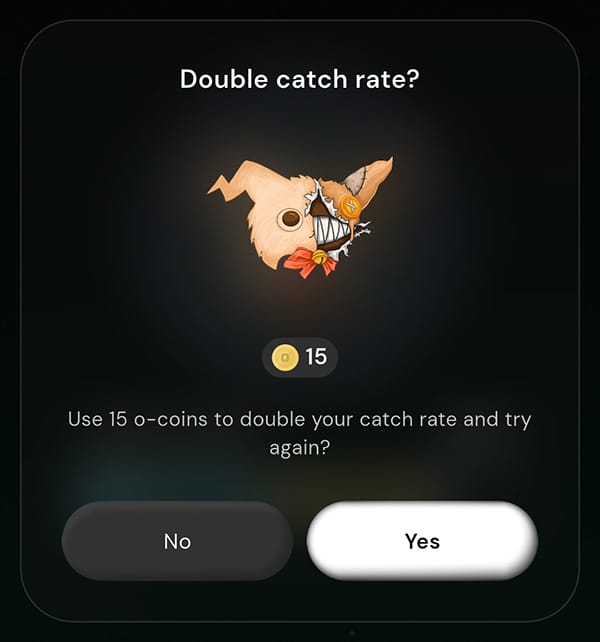
- Failure allows you to double your odds and try again for Ø15. I don’t know if this is repeatable, and I don’t plan on finding this out either. This should strictly only be used to whale three-hour failures of 3☆ and 4☆s for their Superpowers, since you’d otherwise be spending something to get nothing in value.
- You have an hour to catch the Oyster after the timer is complete, otherwise the attempt is annulled. Nice try – don’t bother minmaxxing; it’s not worth playing this gacha as an overnight idle trainer.
- You aren’t limited to one catch a day, making it much easier to f– farm Oysters (okay, that was a good one, O3). Each Oyster has a minimum period before cycling out that seems to be around
3060 minutes, so you can’t set 10 minutes on 1☆/2☆ trash or a dupe to get rid of it. Again, nice try.- However, because of this cycle-limiting behaviour and how longer study periods have diminishing returns, you actually have the best chances of capturing an Oyster by rolling lower odds multiple times.
- The alternative is to throw the session (i.e. intentionally stopping the study session) to force it to leave. If you do this, though, you increment a “sessions ruined” statistic. Just like you wouldn’t pop the first-time double bonus (Google) in a gacha game, or (heaven forbid) shade your hard-earned card (Forum), you wouldn’t want that number to be anything other than 0.
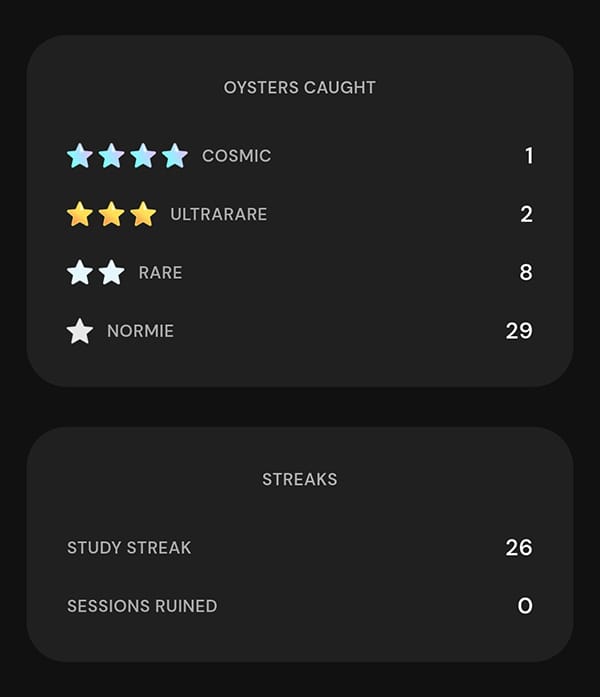
A week after the July 25 update, a few changes that I’ve noticed had occurred, albeit silently.
end of july update
- Catch rates have been reduced. They used to be 80%, 60%, 40%, and apparently 12% (12.5%?) or 10%, according to screenshots.
- Maximum people per study session increased from four to five.
- Unsure if the same rates, but during the July 25 update, each friend added into a session for a 4☆ adds +2% (+2.5%?) chance.
- Catching duplicate Oysters allows you to release it for a certain number of O-coins (1☆ gives Ø3).
The catch rates for 3☆ and 4☆s have been rightfully reduced. You gotta remember that the benefits you get from their Superpowers are permanent, so O3 can’t exactly be giving them out willy-nilly.
august updates
August 11
- Rerolling an Oyster now guarantees giving you one you don’t have yet.
- The ability to release duplicate Oysters for O-coins appears to have been removed.
- At least on Android, you can whitelist five apps that won’t lock you out. In this specific update, O3 only lets you select apps already pre-installed with the phone, or those from the Play Store. Anything from F-Droid or manually installed via other means won’t show up.
- Social aspect implementations introduced around study sessions: lobbies, group chat invitations, session results, lifetime results, etc.
August 18
- 4☆ maximum rate reduced from 8% to 7%.
september updates
At some point, the app list was extended to include wider categories and manually installed apps. I know friends who use Discord as an avenue of communication for non-social reasons (e.g. housemates), so by enabling these apps, you’re really only cheating yourself by being dishonest.
v3 updates
October 21
- Rates are now stated to one decimal point. This confirms that the maximum optimal yield for 3☆ Oysters is 10 minutes @ 2.0%, not 20 minutes.
You could derive the optimal sweet spot balance between time and odds for maximum yield, just like how there is a curve for balancing critical chance and bonuses in games. If my maths is right, peak efficiency happens at the 30-minute mark for 1☆ and 2☆ Oysters. Going from 90 to 120 minutes for a 1☆ yields only half (~52.2%) the efficiency.
I might cover the sweaty math – which really only involves basic division – at a future date. But until then, I’ll leave the rates up to you to visualise and calculate. Based on what I’ve investigated so far, the efficiency curve for all rarities are skewed roughly the same. Before the v3 update, percentages were rounded to the nearest whole number, which made the sweet spot unclear for 3☆ and especially 4☆s.
Of course, at the end of the day, weigh up whether those odds are likeable and worth it for the discounts. By ‘worth’, I mean both O-coins and timewise; three hours is inefficient, but it’s set-and-forget. Having to break your attention on whatever you were locking in to every half an hour can actually end up being more distracting and taking a hit on your productivity.
And, like all gacha, spend responsibly.
Chat
Upon scanning in to a place, you’ll enable yourself the capability to talk in the otherwise normally read-only, venue-wide group chat. Naturally, you also can freely DM the people whom you’ve added as a friend at any time.
In a two-storey hall of a max capacity of 160, the venue chat is incredibly useful to communicate with everyone in a situation where doing so would be meaningful:
- Need to borrow a power bank, pen, or get some sheets of paper? Try your luck asking if someone’s got spares.
- Looking for someone to play chess with downstairs at the pond? Broadcast it.
- Got a 4☆ Oyster encounter and want to increase your odds? Say you’re open for friend requests to make it happen.
But see, this would’ve been useful if the group chat wasn’t given the affordance to be so… group chat-ty.
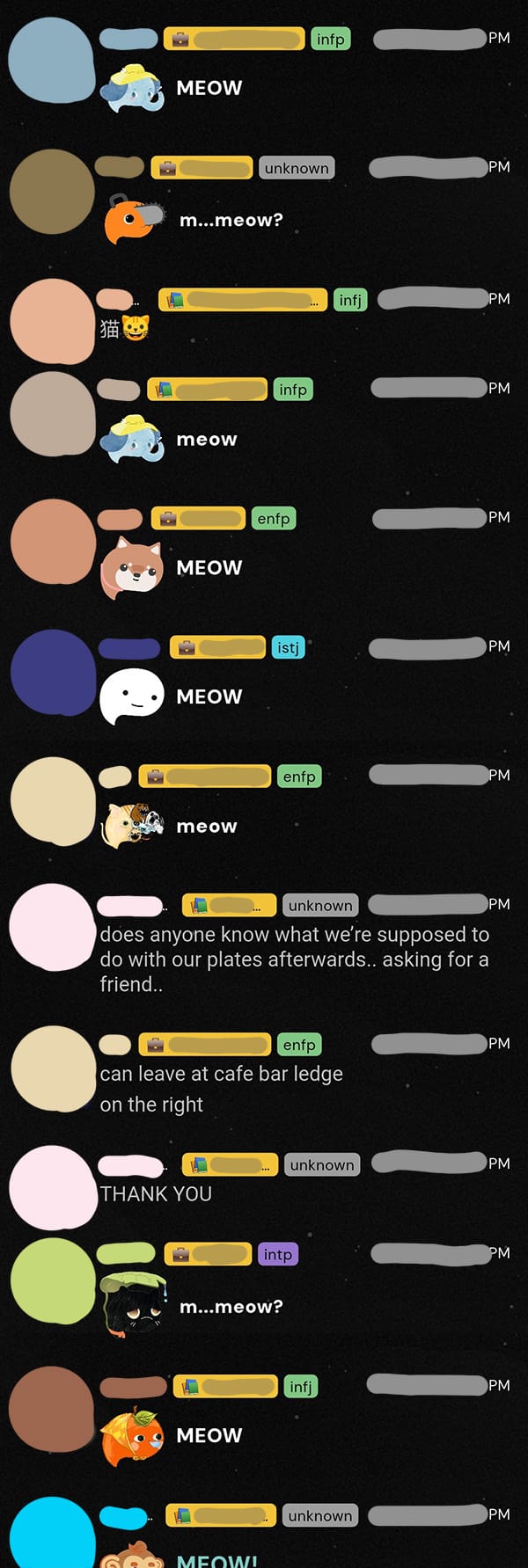
I don’t know what’s the greater demise: having a conversation channel be dead but useful when necessary or be alive with spam but have its reputation hit rock bottom.
Meowing, a one-touch button that can presumably be held to make your voice larger – something the staff encourage as a part of their member culture, mind you – contributes to at least 95% of the volume of messages (sorry). Maybe even slightly higher if we’re talking in terms of screen space, only curbed by the fact there’s the capability to post images.
It’s not the best impression to leave (confusion seems to be the main sentiment), especially for those who were hoping to use the group chat as a discovery channel to make some genuine connections. So, what do I think might help solve the problem?
- Make it more like Discord in terms of having a few channels and/or staff-only announcements. Though, channels would open the can of worms in regards to then requiring moderators to maintain compliance.
- If they go ahead with it, maybe restrict certain ones from meowing. Even having one from a total of two (say, general + open/random) might just be enough to do the trick.
- Filter meowing by having it as an option to completely hide or collapse summarise (e.g. profile icons +
[a few profile names] + “ and ” + [number] + “ others meowed. Expand…”). The flip side is that it might encourage even more spamming whilst at the same time others will immediately go and activate the filtering, killing the original purpose/charm of meowing.
As a lurker with a habit/necessity to monitor the Discord channels of the servers that I’m in, especially the dance game ones due to my involvement in the community (I used to maintain an arcade cabinet I formerly owned in the city), I’ve done my due diligence and kept up to date with every last message that exists in Newtown’s group chat.
And I can confidently say that, for most intents and purposes, those who have ignored the chat are fine and haven’t really been missing out on much.
Uhhh, well, “much”… haha…
O-coins and other freebies
Before the 25 July update, outside of purchasing, O-coins could be earned at the rate of Ø1 for every 60 minutes you were scanned in. They’ve paused that temporarily, with the current gacha system having soft-launched as a replacement.
One of the main reasons to keep an eye on the chat, in multiple meanings of the word, is that, outside of conversation, O3 staff occasionally hand out freebies from time to time as a gesture of goodwill (😷 customer retention, ahem). These come in the form of a first-come-first-served, limited redemption count of either a pool of O-coins, whose amount when redeemed seems to be completely random, or café things to give away.
The O-coin distribution concept sounds confusing, so here you go – a few pictures will explain it better.
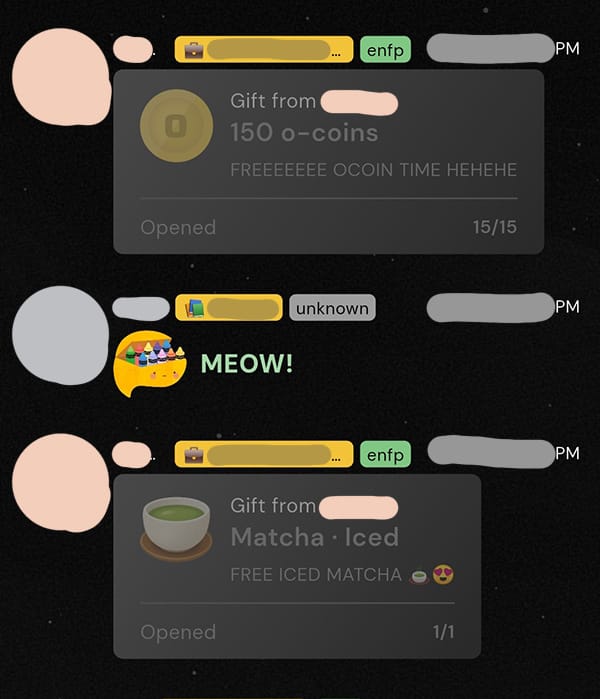
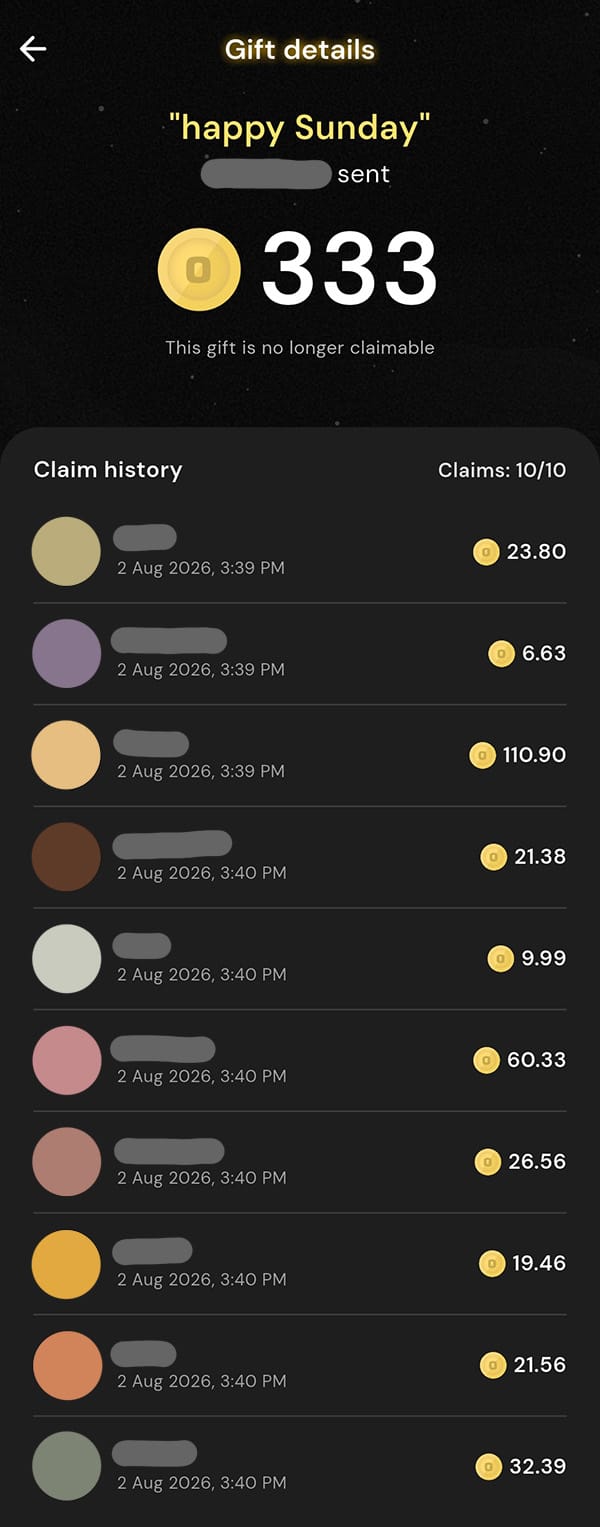
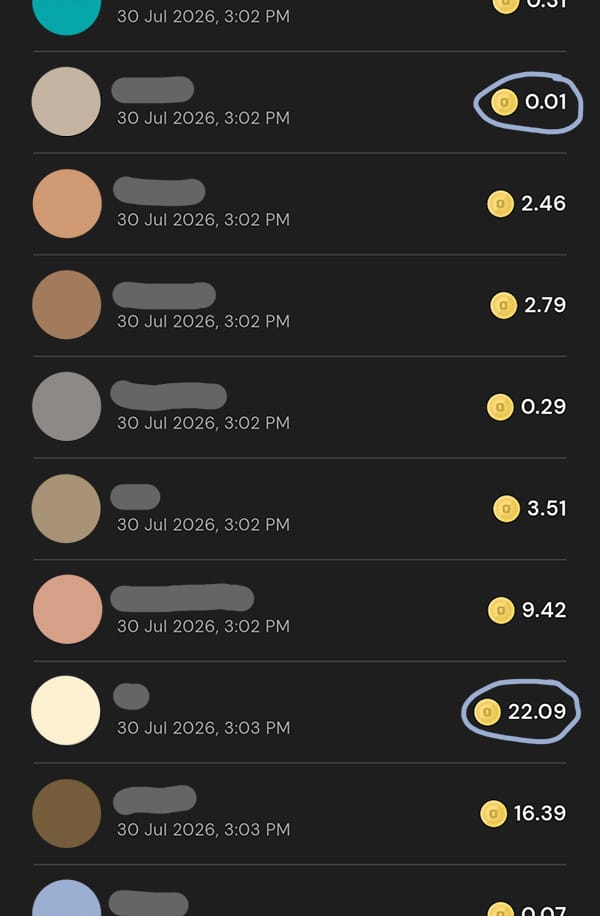
idk if anything influences or determines how much you get out of the total pool, but yeah. that number isn’t each, it’s the total
Look at that – 110 hours of grinding (back when you could grind), BOOM, just like that. Obtained with a simple tap of a button. On the other hand, you might get extremely unlucky scraping the bottom of the barrel getting Ø0.01 for what should’ve otherwise been an average of Ø10… F in the chat, y’all.
Due to the random distribution, you ideally want to delay redemption as much as you can, because:
- At the moment you redeem, you are accepting the average of the pool
- Historically, lower than average redeems are more common than higher ones
- As the claim value is random, every redeemed value lower than the average increases the pool’s remaining average (and vice versa)
- But, high value claims near the beginning (e.g. 30 left → 29) influence the remaining average claim much less than later (e.g. 3 left → 2). Examples:
- Ø200 with 10 claims left = Ø20 average, extremely lucky Ø74 claim leaves Ø126 with 9 claims = Ø14 average (–6)
- Ø40 with 2 claims left = Ø20 average, unlucky but very possible Ø5 claim leaves Ø35 as the final grab (+15)
Of course, I can’t expect you to mentally calculate and track the averages of what’s left in real-time. So, the process boils down to a spontaneous ‘you happened to be looking at the chat at the time’ kinda deal. And then getting called out for focusing on the chat instead of focusing on your work.
Redemptions for free drinks happen instantaneously, within a few seconds. Okay, maybe several, because some may not even be in the mood for a matcha that late in the day anyways.
Not me, though. 11 PM coffee run, anyone?
Profiles
Before the July 25 update, the home page below the gacha roll function displayed a list of members who were scanned in to the venue, each having a thumbnail screenshot of their profile page in the background of their entry. This allowed you to quickly scroll through and view everybody’s profile at a glance.
But the majority of the members who use the study space haven’t bothered spicing up their profile page, so this who’s in section instead became mostly a deep, black sea with each person’s MBTI sticker and their study/work in big letters, those being the only things differentiating one profile from another.
More critically, it also gave the impression that O3’s focus was primarily to have a place to hang out and meet new friends, rather than actually be what it was supposed to be: a study café.
The update gets rid of that long list, replacing it with just two buttons: Friends, and Café.
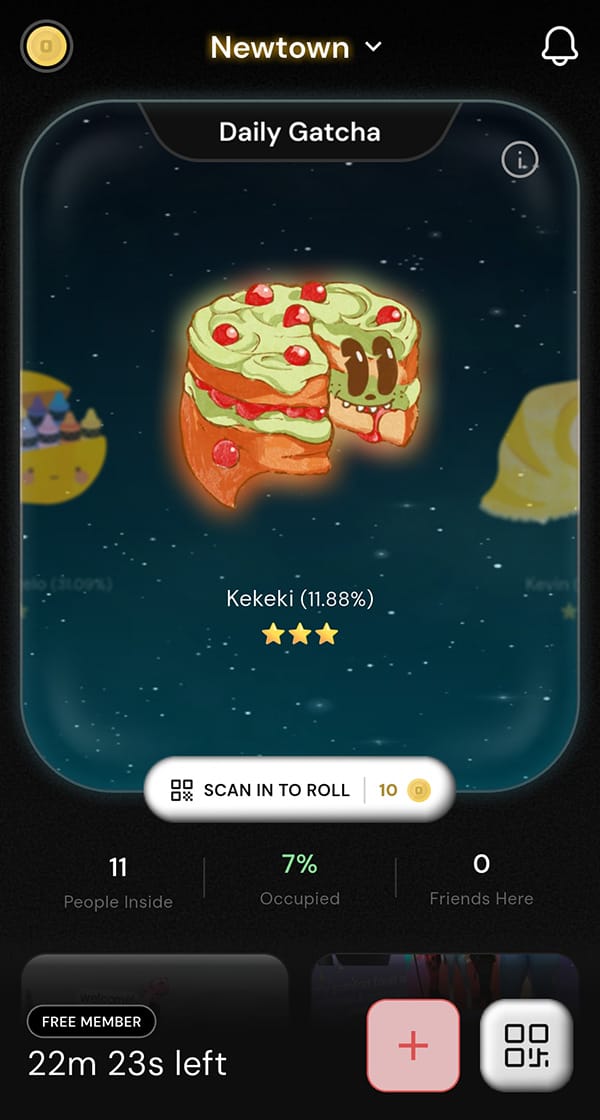
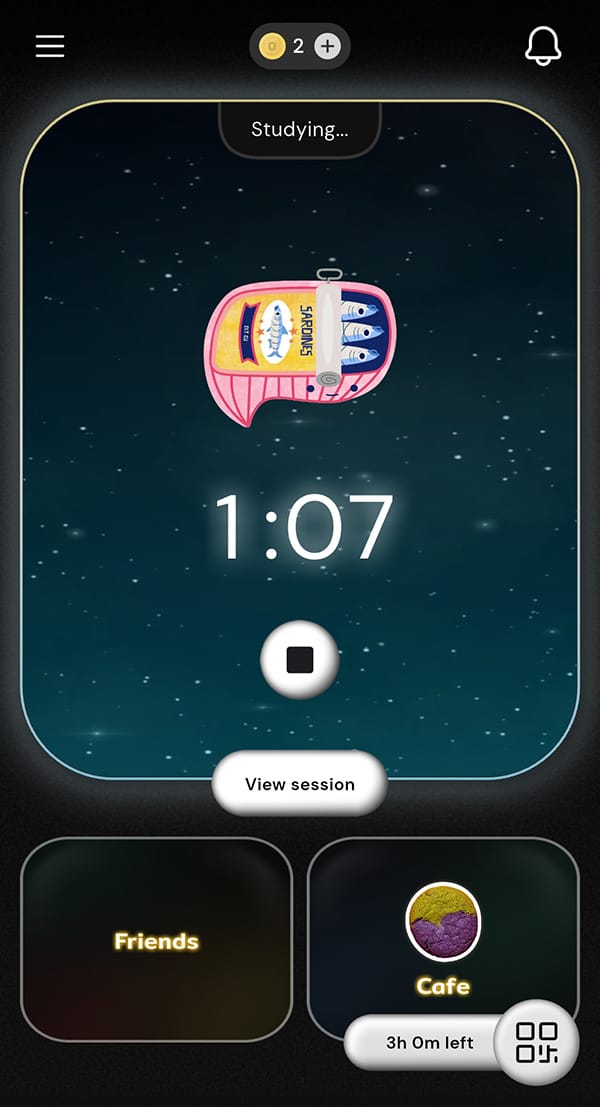
note the profile pages just below the venue selection and stats, which have since been moved into the café button
You can still view who is at the venue through either:
- Home → Café → select venue (in this case, Newtown), which shows how long each member has clocked in for in ascending order
and the Oyster they chose, i.e. not the display picture; or - DM → select venue’s live chat → tap anywhere on the Live Chat header text, which
doesshow their display picture.
From there, you can then tap on the person in question to view their profile page.
(v0.4 Edit: The August 11 update changed the user icons in the venue café screen so that members now have their display pictures shown with their selected Oyster instead of the just the latter.)
As much as I appreciated this update taking a step back from the social app vibe it was initially going for, I kinda do low key miss being able to gauge what everyone’s personality is based on their profile page, something I now need a few more taps to get into. It’s a fair compromise.
Seating
Whilst I’ve explicitly mentioned in the side A article the high bar-table seating on the mezzanine-like sides of the second floor, the regular seating at tables on both floors, and a brief mention of the existence of sofas and beanbags, what I failed to mention was the final elevation option available: low seating. It’s also the most fitting one for the space.
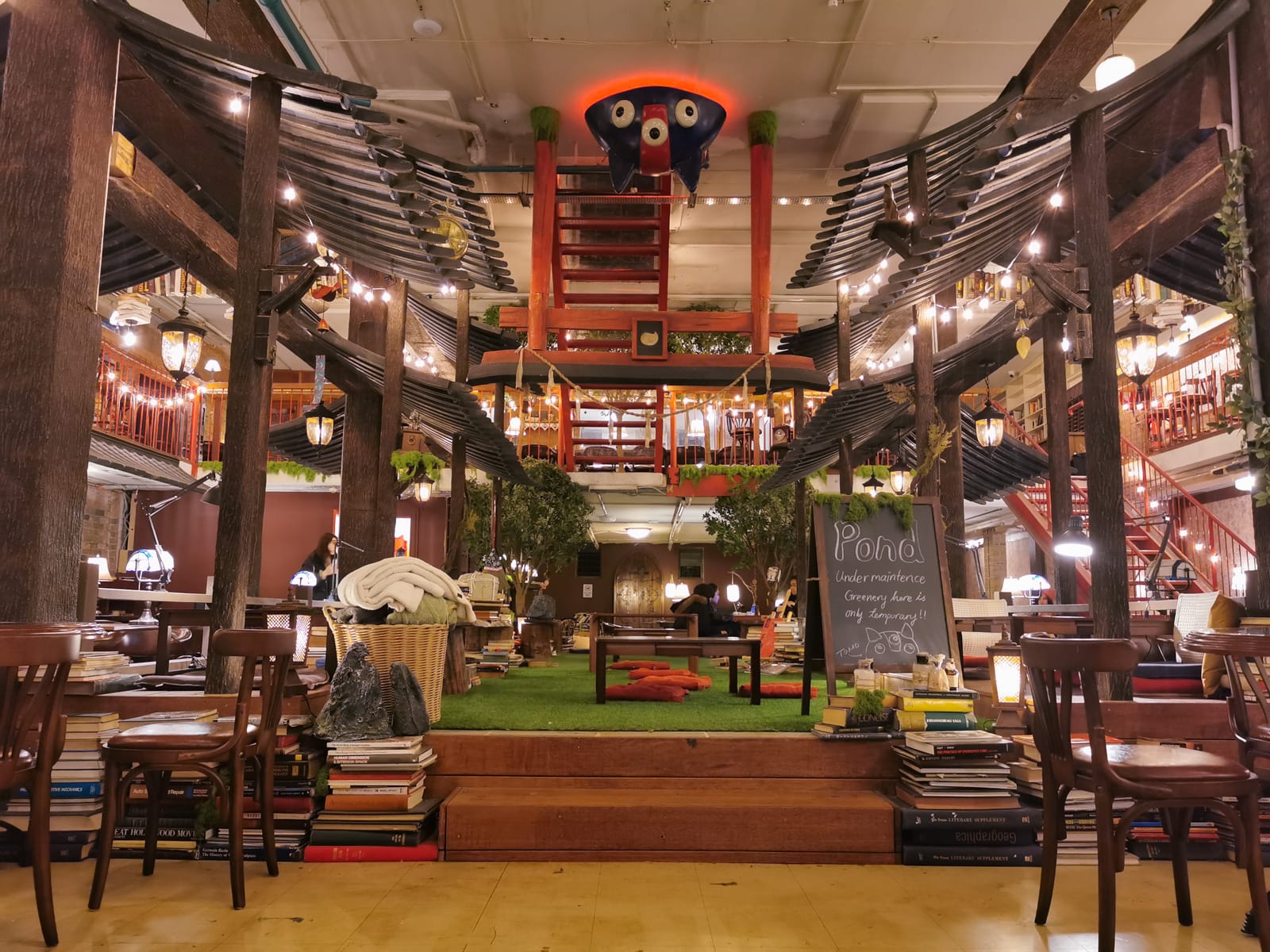
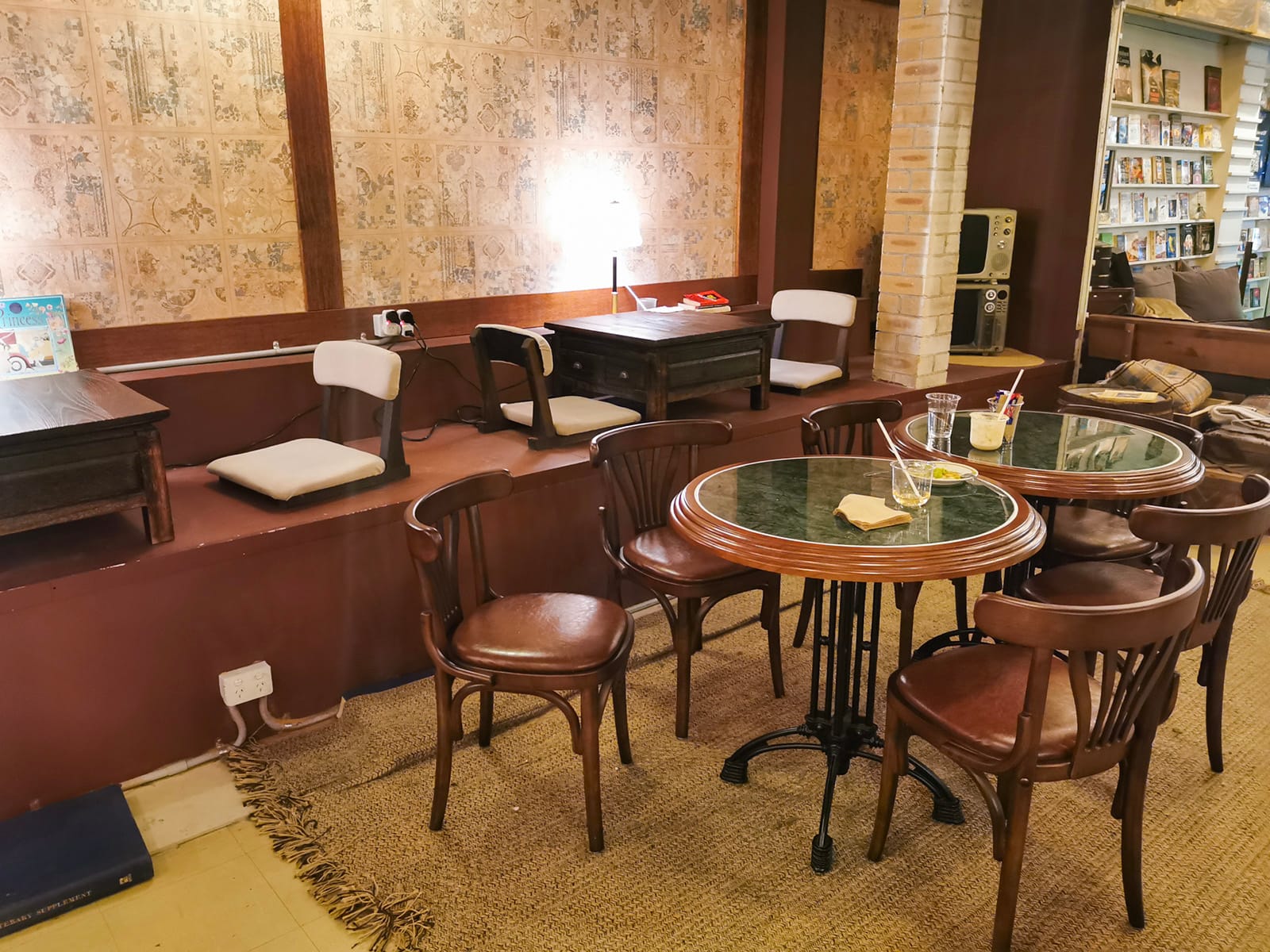
like the wi-fi password, I think we just gotta accept that left rubbish will always be a thing
The pond and the elevated east side of the hall have low tables complete with floor cushions (zataku and zabuton, if you must) that you can sit at however you like: cross-legged, sideways, one up one across, seiza, or maybe both knees up slouching and crouching when you really can’t afford to lose that 40% deductive reasoning ability. If this kind of sitting is something that speaks to you, this spot covers it.
I’ve always associated low tables with gatherings at friends’ homes to do work or study over snacks – which in reality was dinner made by the host’s parents, because they’d insist it’s better to stay and eat something first before you leave, what with all that earlier brain power expenditure. Whilst O3 can’t exactly emulate the close-knit environment of that, it definitely gets further than a table at the State Library.
Is It For Me?
So how do I feel about O3? Well, there’s multiple aspects to it.
Most visitors, especially the students, seem to unanimously agree that what is offered is top-notch. Same here; compared with other alternatives at the same price point and environment (well… there’s none in Sydney, to be fair), I’d say it’s safe to say O3 is up there, setting a high bar.
What’s not as unanimous is the how. Some don’t “get” the concept, and this is where these people hop off the so-called funnel. I’ll cautiously comment that a paid communal space does sound odd only because, for them, there wasn’t a need to need it yet.
Like, coworking spaces was not an option on my radar until I was told to take a serious look at them – and it turned out to be the right solution for me. For others, home isn’t a viable place to study, for a multitude of reasons. So, whilst I do “get it”, I understand it’s not for everyone, every time (the latter word being the emphasis).
Alright, the what and the how are the first two layers, but let’s get deeper. Even less on the mind of the average visitor is O3’s overlying purpose and its “ways”. This one needs a bit of unpacking.
If you were to step into the space and sit down at a table, you’ll feel a sense of implicit trust, something I mentioned earlier. Of course, there’s many intentionally designed factors to support that feeling, be it the visual and interactive environment, the succinct transparency of O3’s terms, or staff just being highly available and there with the members as apart from being there for them.[13]
All of it creates psychological safety, giving permission for people to just be themselves. Now, I understand opinions around making oneself at home are a fair bit more divisive when it comes to working, what with setting healthy boundaries and all that.[14] But with gaming and studying – mainly solo activities – I’m of the view people perform better in an environment that they’re comfortable with.
Contrast this with the workplace, where people often present veils of “work modes” or having to show a different face, putting on a filter of sorts. This puts a damper on creative productivity and problem solving.[15]
At O3, you’re all just sorta doing your own thing in parallel, at maximum potential, knowing that other people are doing the same. And because you’re in this highly social place and the group chat is just… there for you to use, some will feel inclined to shout into the void and ask, “So what y’all doing?”
Others might answer in return. Or straight up say so unsolicited at other times.
“Suffering in maths. Anybody here down to help us out?”
“If you’re working in the government, I’d like to chat with you for a research paper I’m writing. DM me for details.”
“Bored and sketching at the moment. Who wants to join?”
“I’m doing free tarot readings near the beanbags on ground floor.”
“Come downstairs to the pond if you wanna do a bit of puzzling.”
There’s a thing my father often says about social contagion, to the point of it being a meme: surround yourself with interesting people, smarter and better than you, and you’ll naturally follow. (Both as a learner and a role model, mind you; this is an exercise in humility.)
With that in mind as we go back to the original question, I think that is what O3’s purpose is. They provide an opportunity – foot in the door, if we shall – for good people to come together and do some real cool shit. Y’all don’t need to perfectly align in your interests with everyone; it’d be impossible to with so many people from many different backgrounds.
But seriously. How often do you get a chance to just chat with an astrologist, published author, professional poker player, spicy doujin illustrator, (and/or maybe a dance gamer 😉) potentially all at the same time, over some café fare and a game of UNO or mahjong?
now •that’s• a purpose I can really get behind.
Returning amidst crowds
So, with all that said, would this be a place I’d come back to week after week to spend my three hours when there’s a whole bunch of other people who need it more than I do?
As I’m allowed the agency to express myself as “that guy with the pad who makes DDR content” and make an image (hopefully positive – like I said, TPO), then yes, it’s better I do return than not. During more off-peak hours, preferably.
But do I have a “genuine” reason to? At the moment, not really.
…Well, outside of the socialising/networking aspect and taking part in a community, or maybe spinning something up on a frequent basis there as a volunteer. (And before you ask, no, I don’t mean dance gaming.)
O3 staff did try floating some ideas temperature checking who might be interested in certain activities. But given that the group chat is the way it is, few responded, at least publicly.
Compared to work
The main factors in whether it’s worth going to a study space for work comes down to the gear you own and the need to be in the office. Of course, that’s with the presumption that work lets you work abroad in the first place.
My current workplace PC is a high-end gaming rig – RTX 5080, DDR5 memory, that kinda stuff in today’s market – that I get to all by myself, equipped with even faster Internet. The catch is that the office’s odd (early) opening hours doesn’t align with my odd (late) schedule to do any personal hobby work, like writing for the blog.
Even if I could do professional or personal work abroad with a tablet and keyboard, it’s something I’d rather go back or stay at home to do. Home means no travel time, costs, or any context switching overhead.
The only reason I would want to physically show up at a workplace is for meetings with my workmate, in which case Newtown would actually be more convenient for us proximity-wise.
…Except that, just like O3’s turnstiles, our workplace also requires scanning on and off to track shifts. Any WFH requests go through email to our reporting managers who then send it to payroll, so doing so introduces a risk of it being missed somewhere along the chain. Payroll would rather we just not if we can avoid it – and so, rather not I shall.[16]
Charting and gaming
With dance gaming, O3 provides a convenient and viable space where I can set down my dance pad for charting (creating choreography content) and playtesting. Think setting up a stall like Beer and Pixels, except you’re more developing rather than showcasing.
But if I’m only hanging around to do “work” of an avant-garde calibre when there’s others who need the space more, it does make it a very hard ethical sell. Every day, including weekends, since I wrote and edited the draft for side B, Newtown has been at max capacity for a majority of the venue’s opening hours (save for maybe the first and couple of last hours).
It would not be appropriate for me to take out a subscription for this reason since there’s little benefit both for me and the others. If I was still a freelancer, that’s when I’d have considered.
Look, at this current stage, if and when the situation calls, I’d be pretty shallow if all I had to me was a decent player on a dance pad.
But don’t worry, with those three hours, I’ve got myself other stories to tell – in its many interpretations of the word – online and offline.
[1] Office as in white walls, not-quite-Herman Millers, and cubicle-reminiscent rows of tables. Contrast that with a space, which allowed more freedom to decorate and express creativity. Think leather couches, rattan pouffes, record players, and pool tables.
At my old coworking spot, whilst the office was a proper office, the communal area was a space, if you get what I mean. O3 Newtown isn’t into delineating the border between these two things… well, at least in terms of metaphysical borders.
[2] I’ve heard of this term being thrown around a lot. Maybe because I’m a Ghibli poser larper, but it’s not really my first thought when I saw the place myself, save for some similar-looking references.
I’d wager it just being used more as a blanket, lack-of-a-better term for an aesthetic versus being a major inspiration, sort of like how I would throw “Makoto Shinkai” around as a term for the style of cinematic, sky-centric, saturated, vertical-aspect framed scenery.
[3] If the drinks aren’t photogenic, at least the more important point is that they seem to rate well on the taste factor.
[4] One of the reasons O3 wanted to create these study spaces was to bring people together, away from the temptation of the shut-in lifestyle that the powerful grip of the online digital space can pull people into.
It’s just, despite that – not gonna I can’t lie – a part of me finds it ironic that the turnstiles are app-gated. Some consider that enough of a hypocrisy to pass on O3 which, whilst the argument maybe a bit misdirected, is honestly fair enough.
[5] I’m not too across the value of the dollar these days, but I’ve seen high school students receiving lunch allowances in the $20s. In my high school days, $20 was a jackpot.
In the worst-case scenario that allowance is weekly (as I’ve heard canteen food are now selling for high single-digit prices), that’s the price of a Gold subscription. Seems affordable, no?
[6] 14:00, to account for those who have a free on the last class and can therefore leave early.
Studying four subjects is the full-time loading for university students, and so part-time would be two or less. Only full-time students are eligible for the half-priced concessional discounts on Opal.
Combined with the fact that travelling during off-peak hours also attract a 30% discount, the cost difference between a part-time student and a full-time student can be as high as 1 ÷ (70% × 50%) = 2.85×.
For the students who are looking to GPA/WAMmaxx but also do a job on the side (hey it me), dropping the study load to part-time to remain sustainable is often inevitable. As a trade-off, they have to pay double instead.
Didn’t you already know you can’t have your cake and eat it too?
[7] Case study: Optus once had a campaign where their unlimited plans were advertised stating its daily cost. How does “$2 a day” sound to you in comparison to “$60 a month”?
[8] These gates are strategically placed there so that anyone on the public facing side can simply order things from the café without needing to download O3’s app to enter.
During the first week of opening, you could only order food from the outside. This works in the visitor’s favour because not only does it pause the timer for a few minutes, it also acts as a purposeful reminder to tell people to take an actual break. I know, you can always continue studying whilst waiting for your Biscoff latte. But… come on. Take the hint.
Except that for free members, there was the potential to be locked out when the place became full. You scan out, someone waiting sees that and scans in, great – you now have no access to your belongings stuck inside.
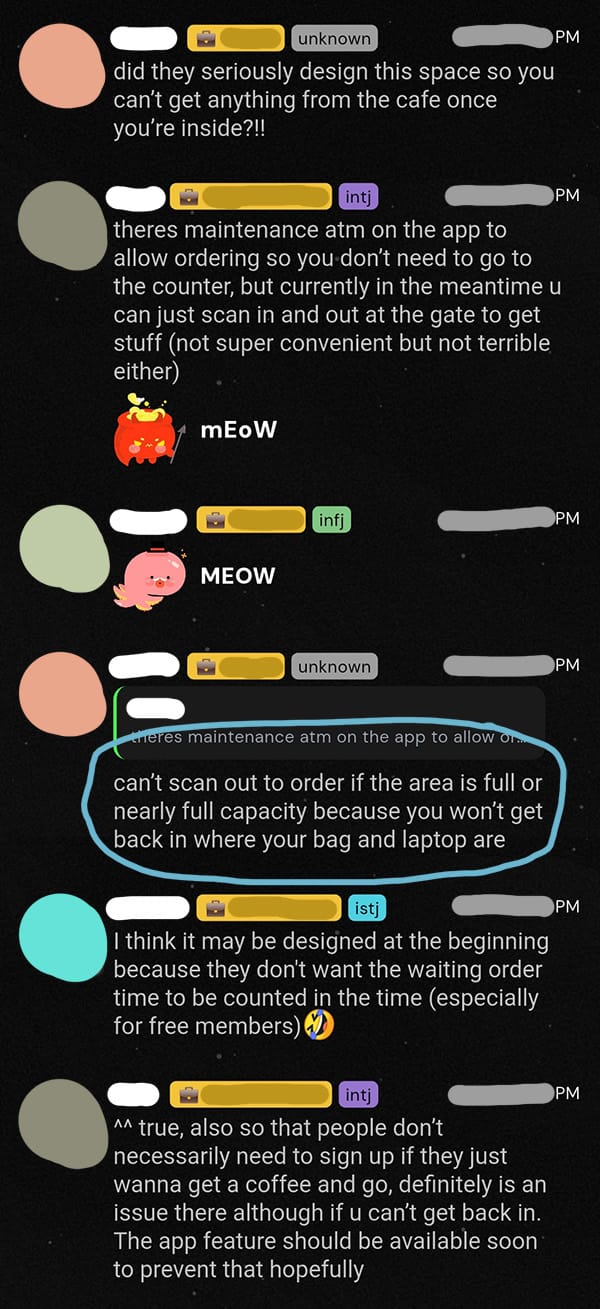
[9] Ah yes, the converse of fare evaders tailgating behind others when going through the train turnstiles. Then smacking themselves clean in the groin when they don’t make it through.
[10] Unless my food container had a lid, or there was a microwave cover there I could wash and use beforehand at a kitchen sink… miss me with that shit. Have you ever tried having breakfast oats porridge with the residual scent of lamb shawarma? Both great food. Just not together.
Also, please tell me you’ve heard of a thing called a microwave cover.
[11] Unknown so long as the blurring filter that the menu is currently subject to renders it unreadable. The end of July update displayed your obtained 3☆+’s Superpowers at the top of the menu – and even through the blur, you could work out the text to state things like “free upsize”, “20% off” (because the digits next to the struck-out price of $9 looks a lot like a 7 and a 2), or “receive [Ø icon]”.
But like I said, none of the Superpowers are set in stone yet – they need a lot of deliberation in balancing the perks out. For instance, that 1/4 you’ll see in the screenshot has since been nerfed to 1/5.
[12] I have no idea what O3 might think up of for their soft pity (gradually increasing odds after a certain number of failures) or what thresholds they make for hard pity (guaranteeing a success after a certain number of failures). Assume there is none until proven otherwise.
Presuming that “1 in 4 chance” to mean the fourth purchase should yield a guaranteed success after three consecutive failures is like saying that the odds of tossing tails is a “1 in 2 chance”, then assuming if you toss a heads the next is guaranteed to be a tails. It might be here in New Sou– So where were you someone lost a coin toss seven times in a row?
Actually, there’s a little less than a 1 in 3 chance of not pulling a free drink after four rolls (that’s pretty common!) So, it’s important to not make any assumptions about such wording when it comes to odds.
[13] Y’know. Helping members out catch Oysters. Freebie giveaways (admittedly, less often now than during the first week). Baristas looking to sneak in a few card games during their break with any members who are also down. Open invites to grab late dinner with the crew after the café closes. It’s very human.
[14] Tangent warning. The tl;dr: is that “third place” is a term to describe a place away from home and work. O3 may have found themselves in a tricky position, since their study cafés blur the boundaries between these three, which is against the point. This shouldn’t be a problem for most customers, but it may be for the more mature ones. •
You might say, “Erm… isn’t the torii supposed to make clear there’s a boundary between the study space and the outside? That just seems emphasise the distinction between home and work, not try to bridge them together.”
Indeed, O3 is giving you the opportunity to make the space beyond the torii as a separate entity that could potentially hold the vibes of both. In fact, the 3 in O3 is presumed to stand for “third place”. But, as you may have noticed, I have reservations in using this term.
Having just stated O3 is like a Venn-diagram intersection of home and work, that is contrary to Oldenburg’s definition of a third place. Third places should have no overlap between the other two, yet the title “study café” implies an expectation that you bring yourself here in your student/work persona, not simply just you.
That isn’t saying O3 must be one or the other; they can be both. Likewise, nobody is stopping you from showing up as yourself – it’s just that you can probably already guess you’ll be the odd one out.
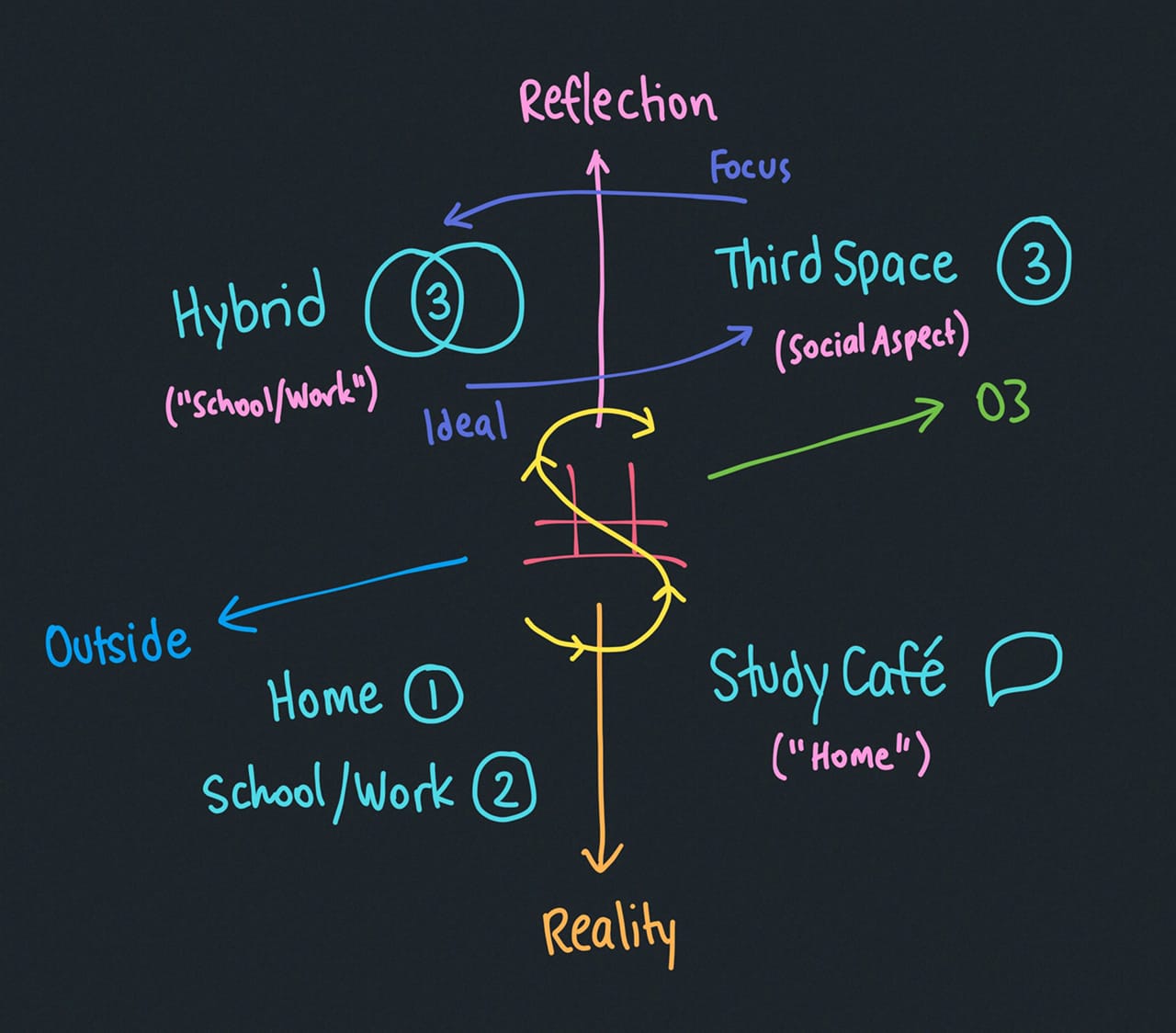
In the diagram above, continuing my torii reflection idea, the customer who comes to O3 looking to make use of the venue transitions from one stage to the next. These stages can be split up between two axes: (1) outside and inside O3 (here I’ve made it the torii gate), and (2) reality (everything physical) and reflection (the “place” in a higher, abstract, or mindful sense).
A vast majority of people don’t really think of O3 more than just what the label says – a study café – and will go on happily with their day staying here. Some might want to approach O3 as a more disciplined workspace, to which the hybrid place would better apply. The end goal, a true third place, is something that could be said as still out of reach for now.
Poetically speaking, the pond truly is undergoing maintenance; it is difficult to cross the torii’s gate when its reflection is masked with green.
Anyhow, O3 have tried some ideas of their own to foster the third place… like the initial social focus on their app. But, as discussed in side A, the approach seems at odds with, or contradict, each other. Perhaps the problem needs to be tackled at a different angle, like maybe establishing small volunteer-run events (hosted in-house would be ideal but it comes with a cost of running).
The issue is that aiming for both could end up being a situation of chasing two rabbits. Point being, I think O3 has put a lot of consideration into how they should best proceed with their current problems regarding this.
[15] “Wait, actually… I really should’ve just drafted Schedule 3 before finalising the proposal. Hmm,” you ponder, as you twist the dial of the gas stove back to its off position thinking it’d be better instead to use the large burner. “Why didn’t I just go ahead with that at work?”
Retrospective thinking. Happens all the time.
[16] Workplace wisdom: don’t fuck with accounting or payroll.
Having only worked in wage jobs prior to my first gig where I was on a salary, I was strict and honest with reporting the number of hours I worked. This apparently made it a nightmare for the accountants, which work pays 💰 to “fix”.
If payroll does things a certain way, like recommending you to show up to clock on/off at work instead of WFH to make paperwork easier or always putting 7.6 hours no matter if you worked 3.5 one day and then 12 the next (which is a sign that there might be some underlying core issues to sort out)… just do it.