

Purikura Photoland – Part II: Bridging Old Groups With New
For more generalised nostalgia on Puri and its surrounds, check out the first part; for similar stores that may hold potential post-closure, as of writing (Jan 2026), check out the third part.
Rolling the Ball
At a time when suspenders and Rabens were in fashion, I went to Puri for the claw machines.
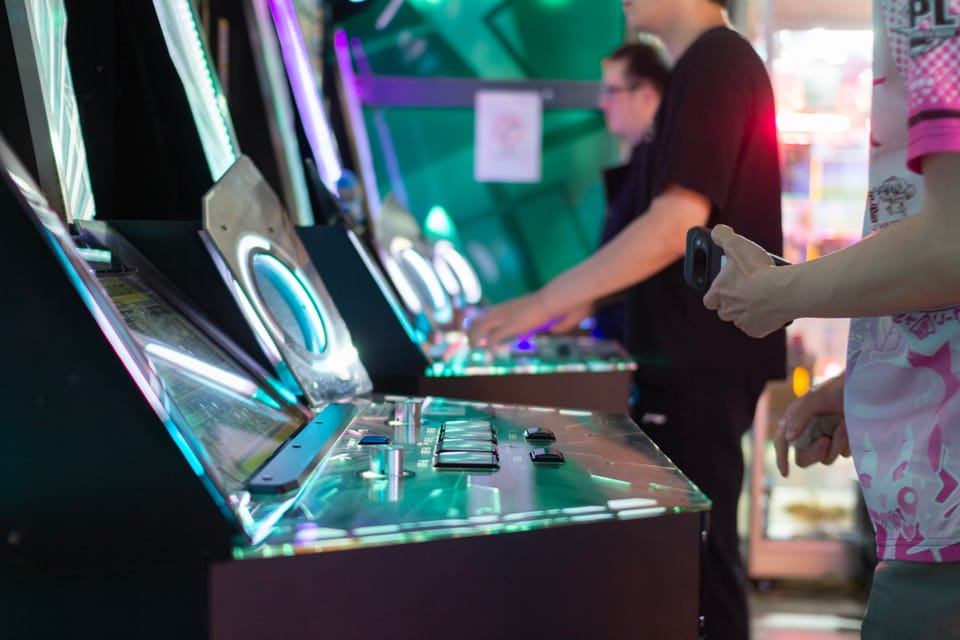
That all changed when a Chinese knockoff of rhythm game jubeat, titled Magic Box, landed there. “jubeat? What rhythm game’s that?” Glad you asked.
Apart from Puri, there also was a Magic Box cabinet at an independently run gaming arcade in Burwood called Dong Man Magic City (since then, to this day, is Burwood Medical Imaging; you can see the cab on the left in July 2013’s street view). Putting aside the unfortunate naming for those not as in the know on Chinese phonology, I’m not sure who got the cab first. But my first time playing ‘fake’ games on this kind of cab was here.
The Spark
What did I mean by ‘fake’? Well, as someone who bought a whole damn iPad for the official mobile port, jubeat plus, it was a no-brainer one would rock up and place their tablet on a space above the buttons to mimic the actions on an arcade-sized cab. We wanted to play real content, not poorly written stuff!
At Burwood, I could easily get away with this; in fact, the staff didn’t care. Puri… not quite. A fond memory of mine was when I saw in my peripherals the boss walking over whilst I was “ghost” playing with my earphones in. He tapped me on the shoulder, gesturing with a flat palm whilst shaking his head.
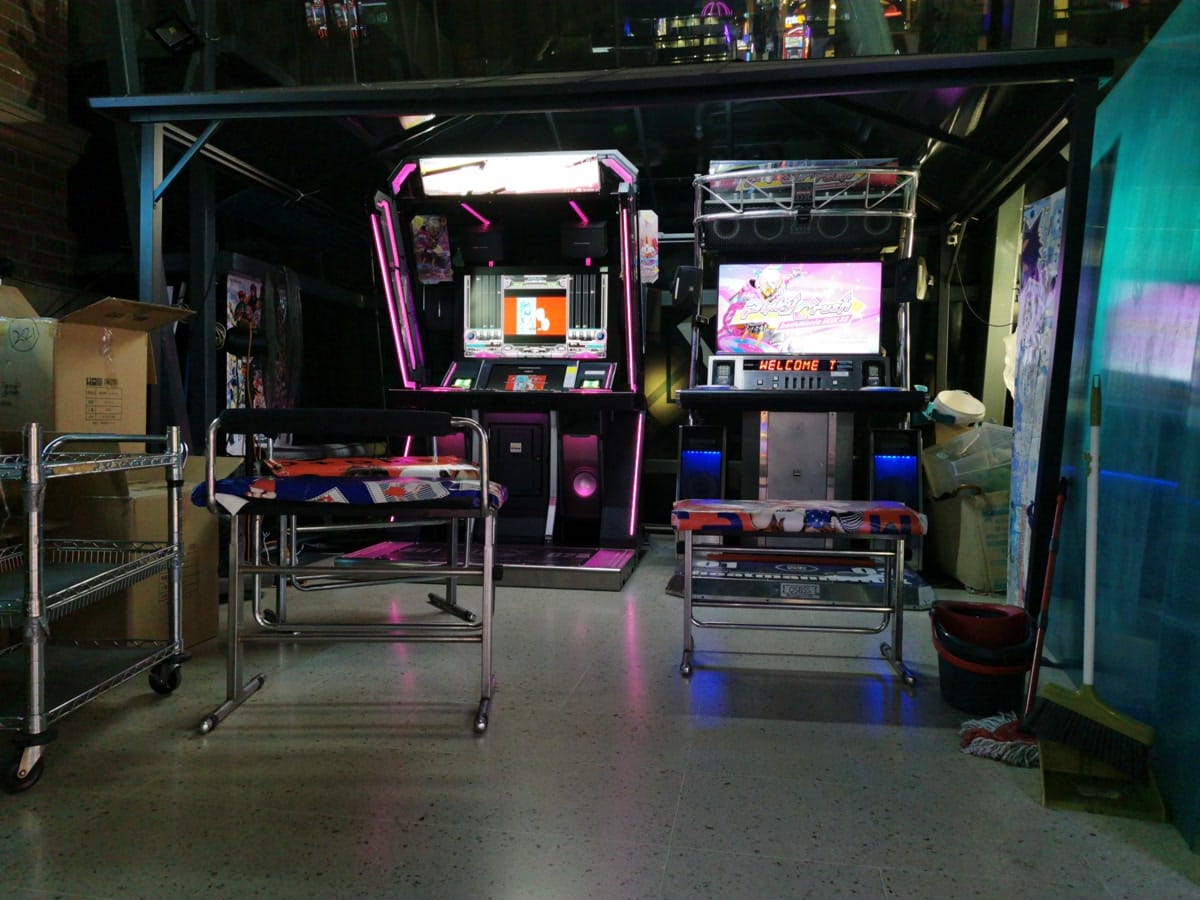
But it asked the hopeful, ambitious question: will jubeat, and other games, be a possibility in the future? After all, the X3 version of DanceDanceRevolution (DDR for short) – y’know, that four-panel dance game with the arrows you step on – was online, albeit intermittently, at Galaxy World George Street until around the month of July in 2012.[1]
At that time, the answer we were given was a resounding no. Except that jubeat actually did briefly become online for a short few months in an arcade. Somehow.
But beyond that, nothing… and not for a few good years. My dramatic headcanon was that it was a consequence of flying a bit too close to the sun.[2] I’m pretty sure it was for other reasons, though.
The Flame
Around March 2018, Timezone George Street, hidden inside the Event Cinemas complex just across the road from Galaxy World, got Australia’s (reportedly) first DDR A cab. That’s the big white-coloured cabinets you’ll commonly find in arcades today. Here’s one in its habitat at the Burwood branch of CityHeroes:
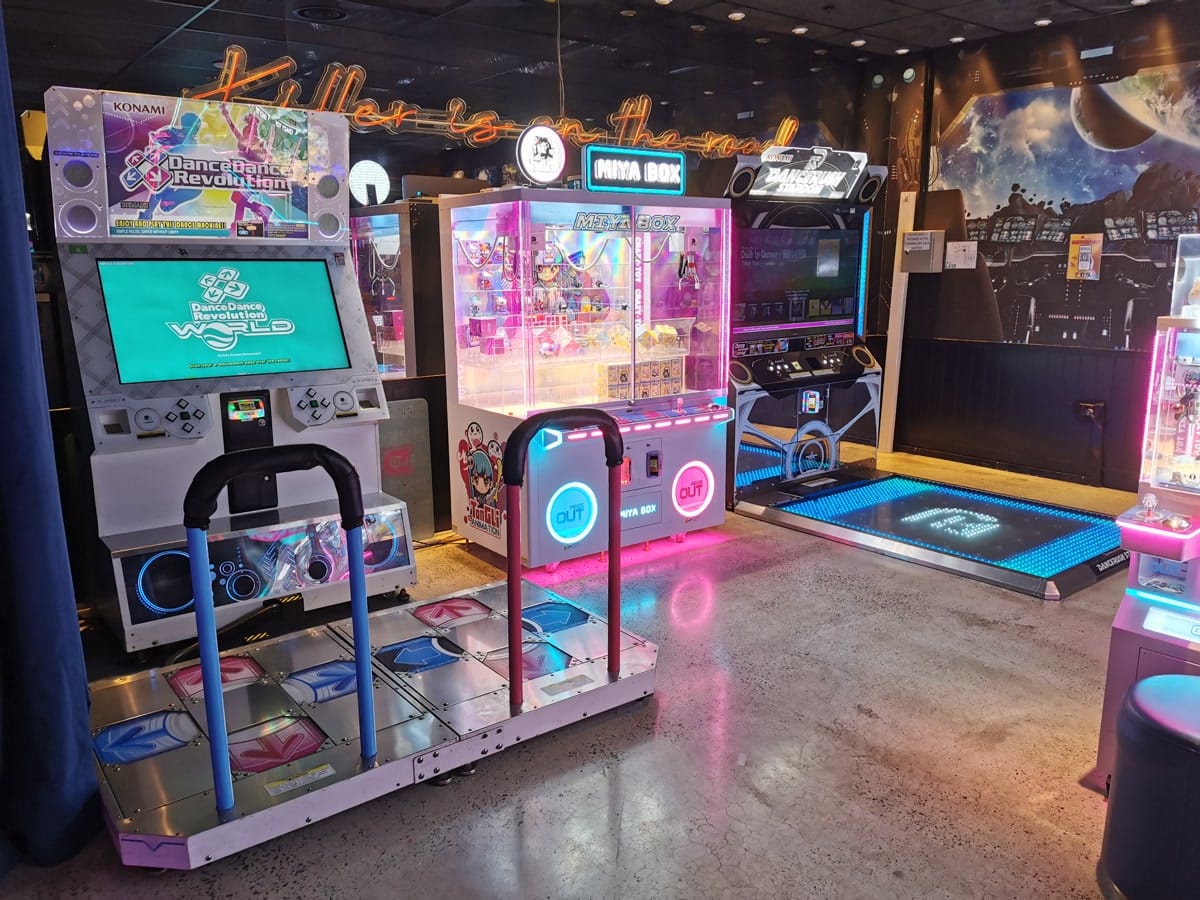
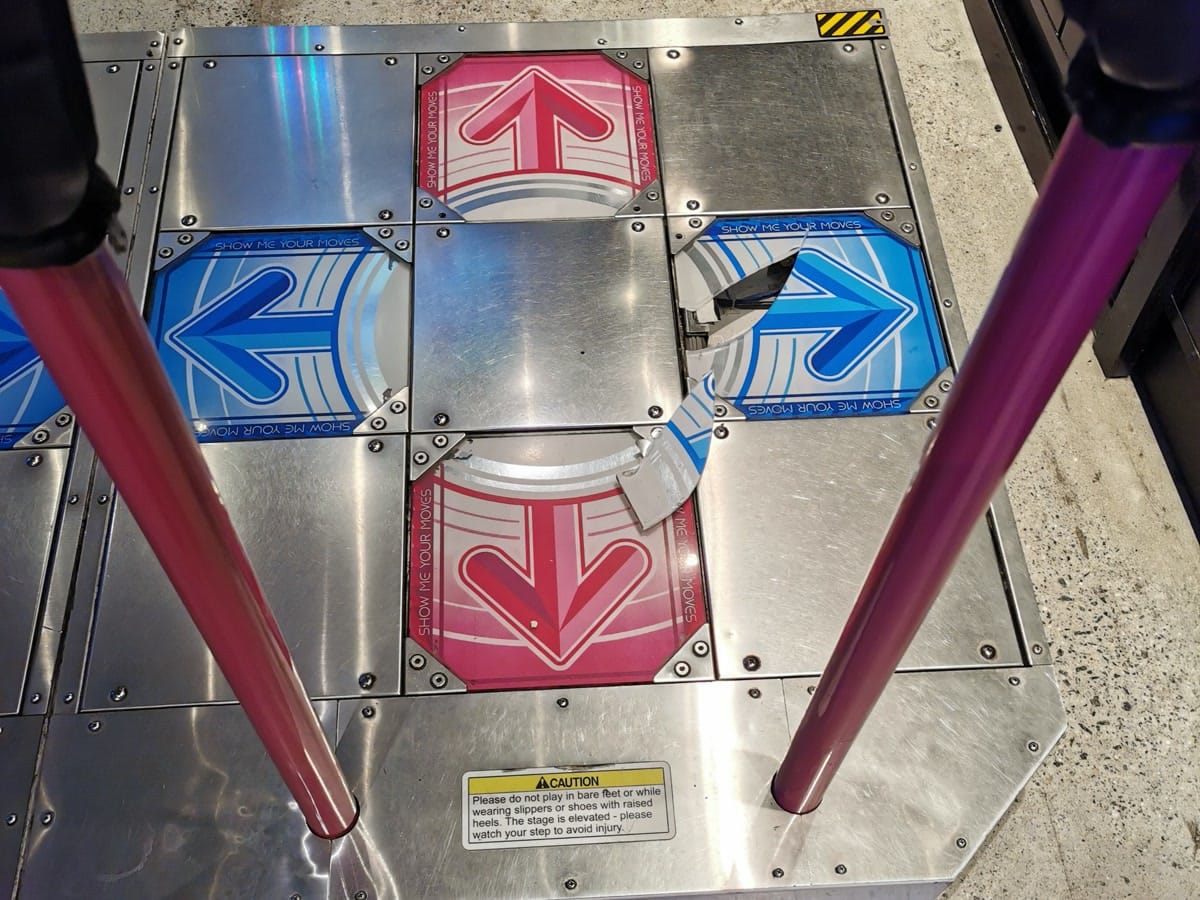
the right side’s panels are like that because these cabs do get their fair amount of abuse throughout the years
It marked the date of when a modern Konami title had official online support in Australia.[3] Things were looking real good, though we kept our expectations reasonable, humbled enough to be satisifed with having anything connected.
But in December 2019, much to our surprise, Puri got its first SOUND VOLTEX cabinet (SDVX for short)… online. And then, not long after in the last week of January, beatmania IIDX (two-dee-ecks) joined the family. It’s like all the stops were being pulled.
This was only made possible with the efforts of a pair of twin brothers and another guy.[4] Together, their communication with Puri’s boss was critical to getting the so-called foot in the door, opening up opportunities for other Konami games outside of DDR to become online.
The Fuel
Further developments in the later years on until now were a matter of riding the momentum of the rolling ball Puri helped initially push. Other arcades quickly found the potential of rhythm games and jumped on the bandwagon, ever raising the competitive bar on what, and when, an Australian could only dream to play here.[5]
And, boy, did Puri make its mark. If you were to look at Wikipedia’s article of IIDX and SDVX, the infobox photographs for both titles were taken none other than at Puri. Global presence, heck yeah. (Contributors, I know you’re reading. Smooth moves, by the way.)
Amidst all of these games popping up one after another, what did the arrival of them mean for me, with someone who had their arcade roots in four-panel gaming, namely, DDR and its “open source” version In The Groove (ITG, for short)?
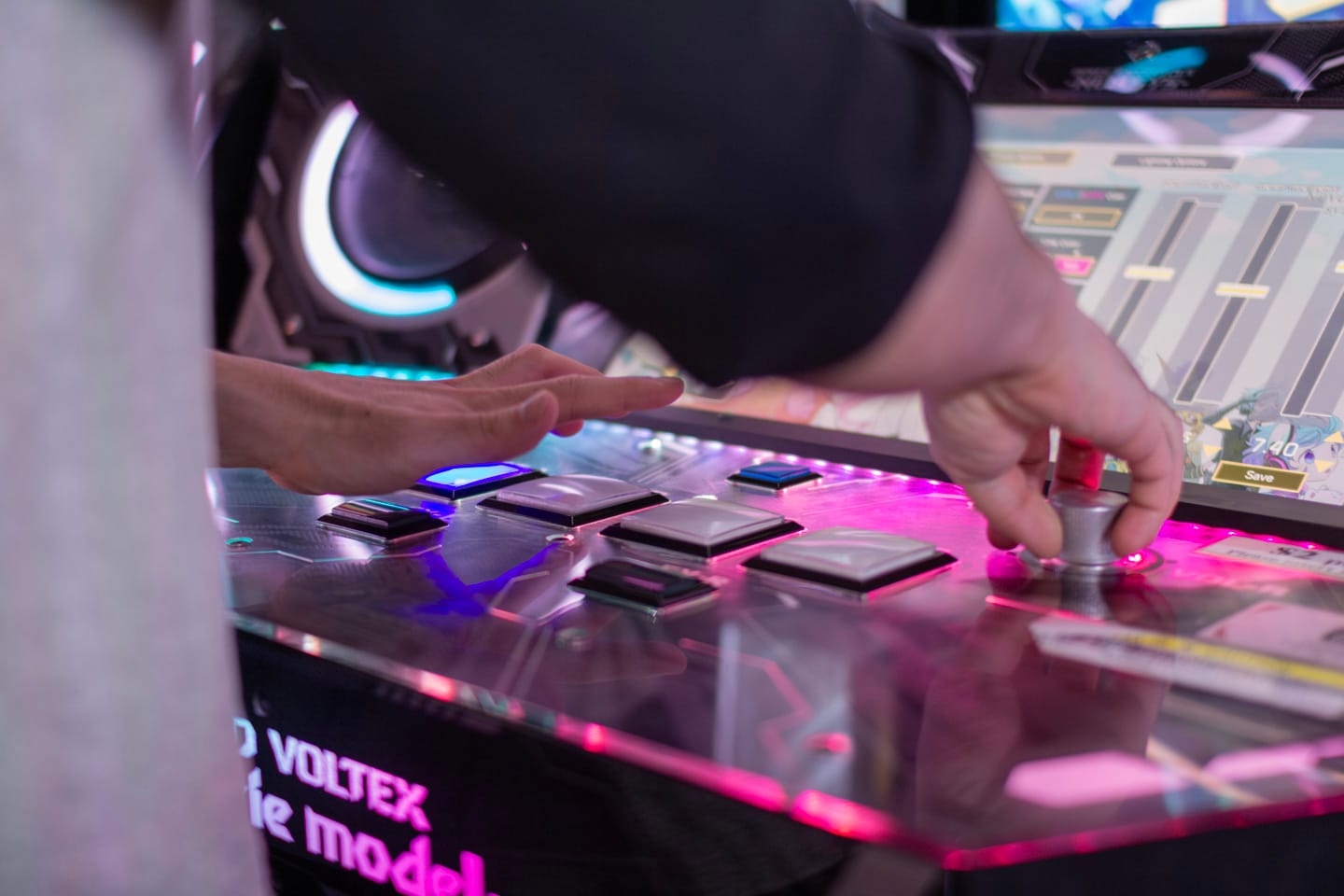
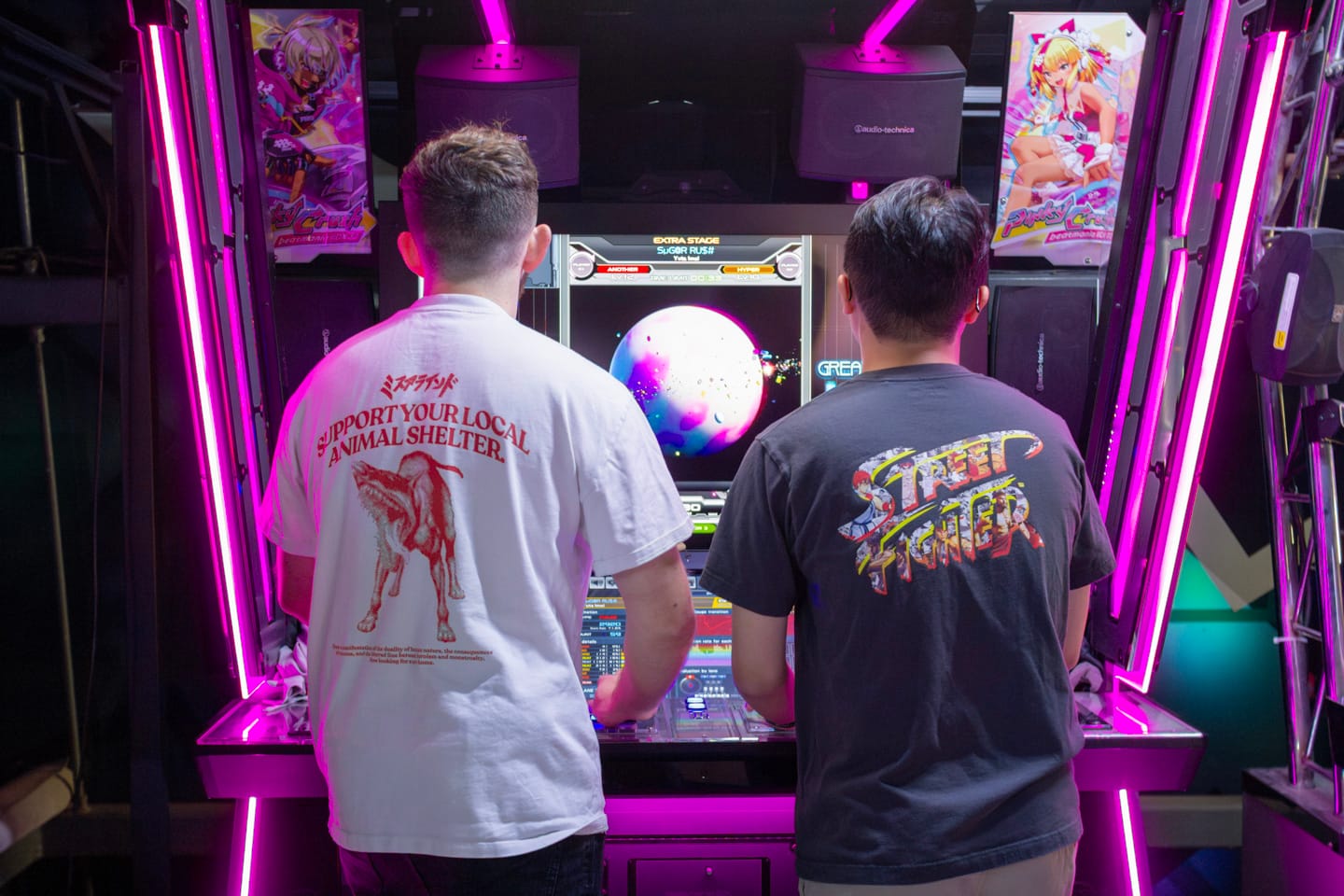
hand games were slightly foreign to me coming from stepmania (ddr but on a keyboard), djmax portable on the psp, and jubeat on the ipad
An Arcade Experience, Revisited
I recall, at some time during my primary school life, Galaxy World Market City had its DDR Extreme cab positioned at the far left of the front entrance facing the yum cha restaurant opposite. The key things I remembered were:
- The spectator and player huddle.
- Types of players, such as those who chose the “national anthems” of the game,[6] or players who went straight for the hardest content like it was morning tea.
- The MAX 300 Heavy rite of passage. You knew you’ve made it in DDR life if you managed to successfully slay the iconic beast.
- The coin queue: a line of $1 coins sitting against the border of the screen and the button panels, stacked left to right, and pushed when the leftmost coin is inserted in the machine. Apart from any special designs, the coins were non-descript and looked pretty much the same, so players still kept a mental note where they were in the line.
DJMax Technika for me was the first game after DDR to have successfully checked all of those boxes, albeit in slightly different manner.
Spectators changed from the passive mum or dad pushing prams with toddlers seated securely in them, to the more active, rowdy folk, who had no qualms getting up close and personal to see (and record) what you’re up to.
Technika most definitely did have its own national anthems and eponymous end-game content. Though players grew out of such a phase pretty quickly, and hard stuff weren’t as glorified into memes.
Payment for games were stored on an arcade swipe card, but we still had a separate card for storing our game data. As these cards had different designs on them, we knew at a glance who was up next. The queue was likewise just as long – and hilariously so, as it snaked across all of the limited space we could make available above the touch screen.
Metal vs Plastic
The introduction of store credit being kept on a card meant arcades could not only have the cost of playing a game be not limited to multiples of $1, but also enabling fine-tuning pricing for one-off visitors and “VIP” regulars (for example, $3.70 and $3.40).

there was once a legend on george street someone lost a galaxy world gold card with $6k in it
Ah, the credit bonuses, too. At Timezone, it feels like every other month is your birthday month, as they frequently offer to double the value of certain denominations of money you put into it. Pay $20, get $40. Pay $100, get $200. True savers stack this deal with student, store, and gift card discounts.
Puri’s credit system, on the other hand, kept it simple silly. Just like the coin queue in DDR, everything was dealt in currencies of gold coins. A coin pouch that held what you converted from a $50 note – a completely reasonable amount for the claw machines, mind you – was still relevant in the 2020s.
…Need I mention that every dollar you had in such pouch stayed as real cash?
No matter if the side angle view, the prediction of the timing of the light skips, or the claw closing tech to push that Psyduck over into the hole were essential techniques in your arsenal… or it’s been over a decade since you last put a coin into a UFO catcher, it didn’t matter. You, and everyone else, were indiscriminately entitled to VIP rates.
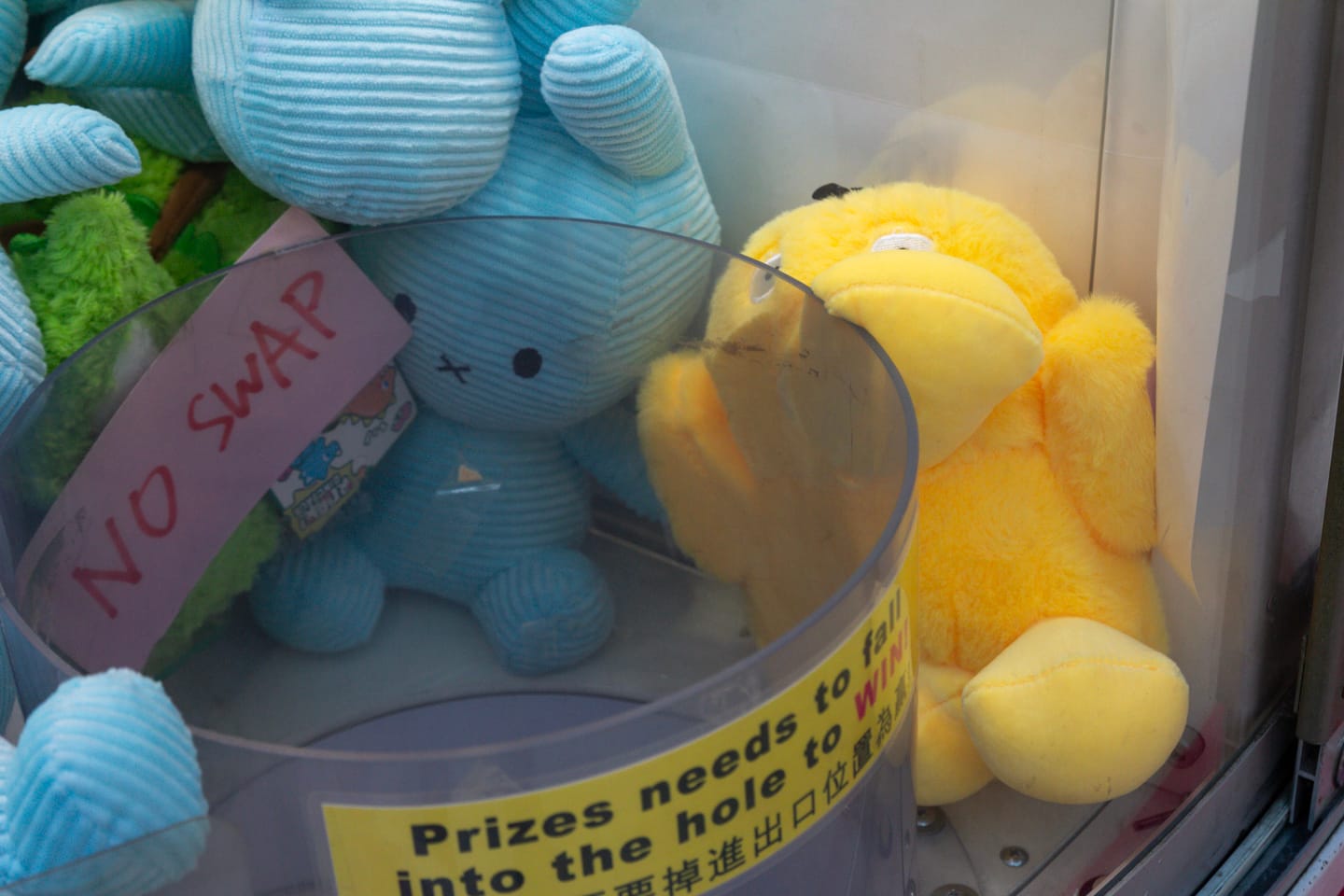
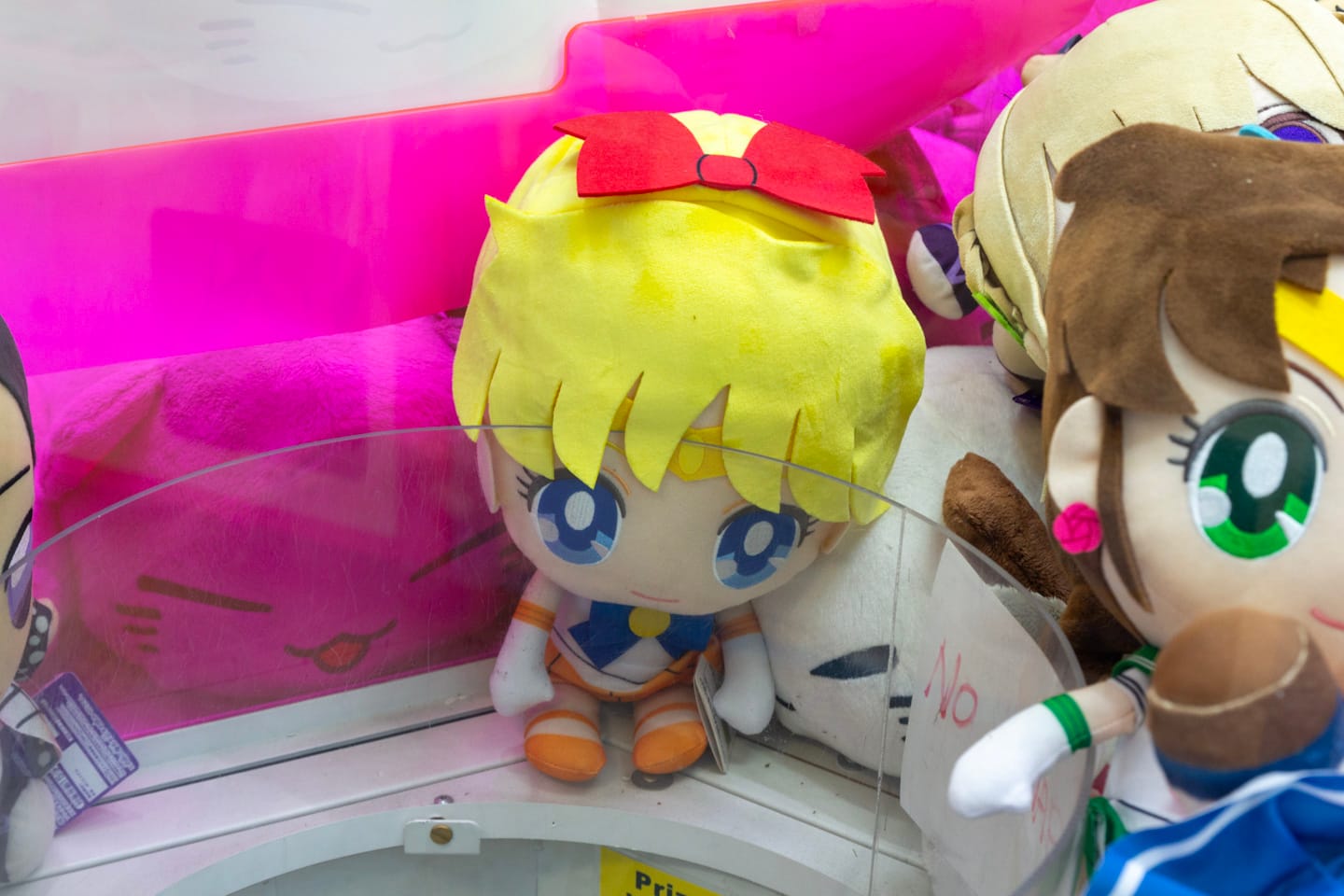
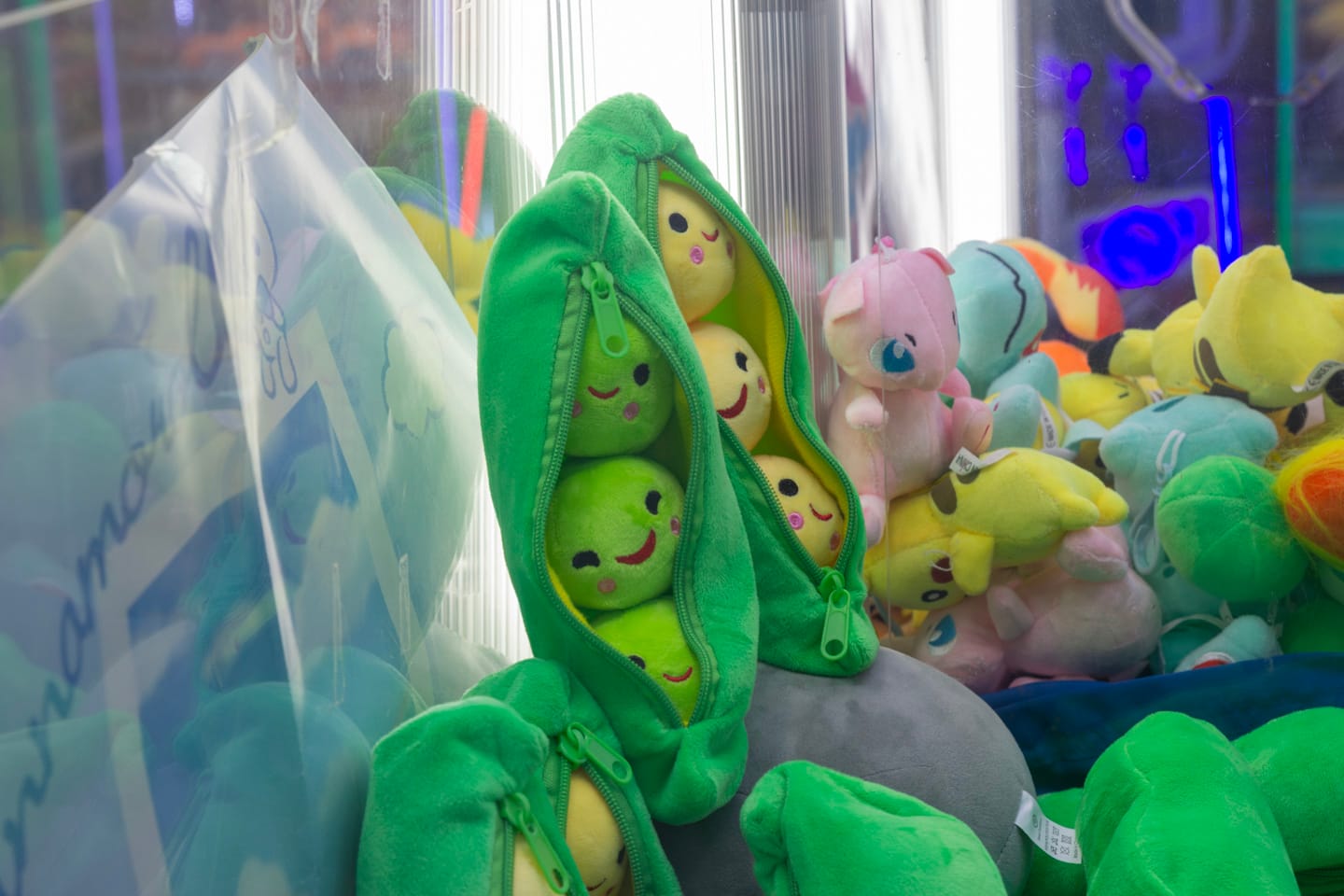
honestly mood with some of these
I’m sure you can think of other advantages and disadvantages, for both the player and the arcade, with having non-refundable credits stored on an arcade-specific card versus dealing with coins.
But as for Puri, they made a choice that worked for them. For the players, the benefits outweighed the drawbacks, and the nostalgia of actually seeing an aging, tape-fixed coin exchange machine definitely played its part.[7]


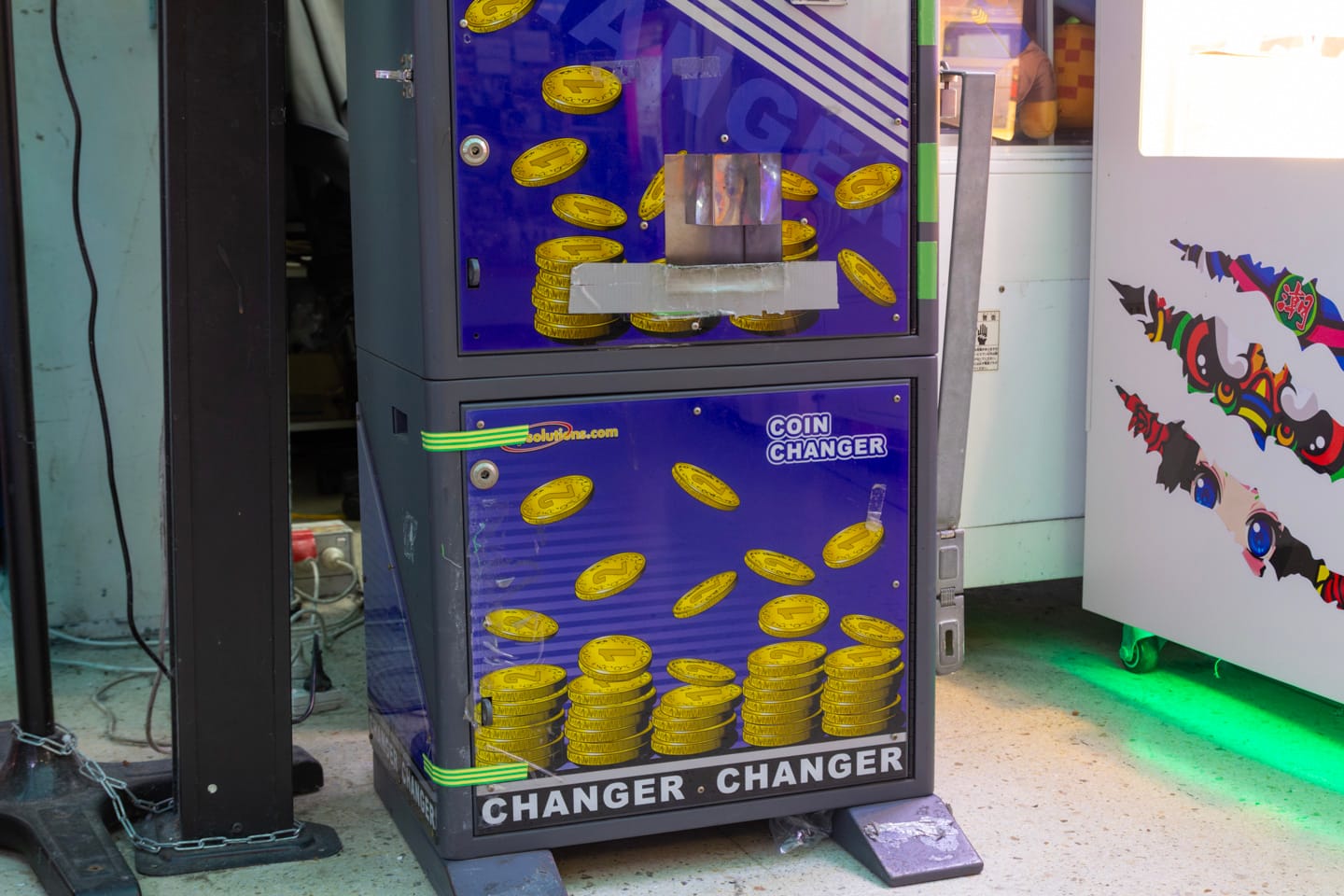
A New Game (+)
The week of Christmas Eve, 2019. At the time, I was compiling and authoring content for an ITG tournament that I was going to host early next year.[8] I was in town to copy what I had so far onto the ITG cab at George Street, and had heard about SDVX being set up at Puri ready to play.
For someone who had never seen how this game worked before, I wanted to spend some time alone to figure it out at my own pace. 10 PM seemed late enough of a time to quietly learn how to navigate its menus.
…Except that didn’t quite happen as planned. As I ascended the escalators (still functional at that time), entered through the glass doors and into where the cabs were set up past the anime figurine shelf, to my surprise I spotted an old mate from Technika days that I haven’t seen for years.
At least six years, to be exact, because that’s how long ago the game’s online services had been sunset for.
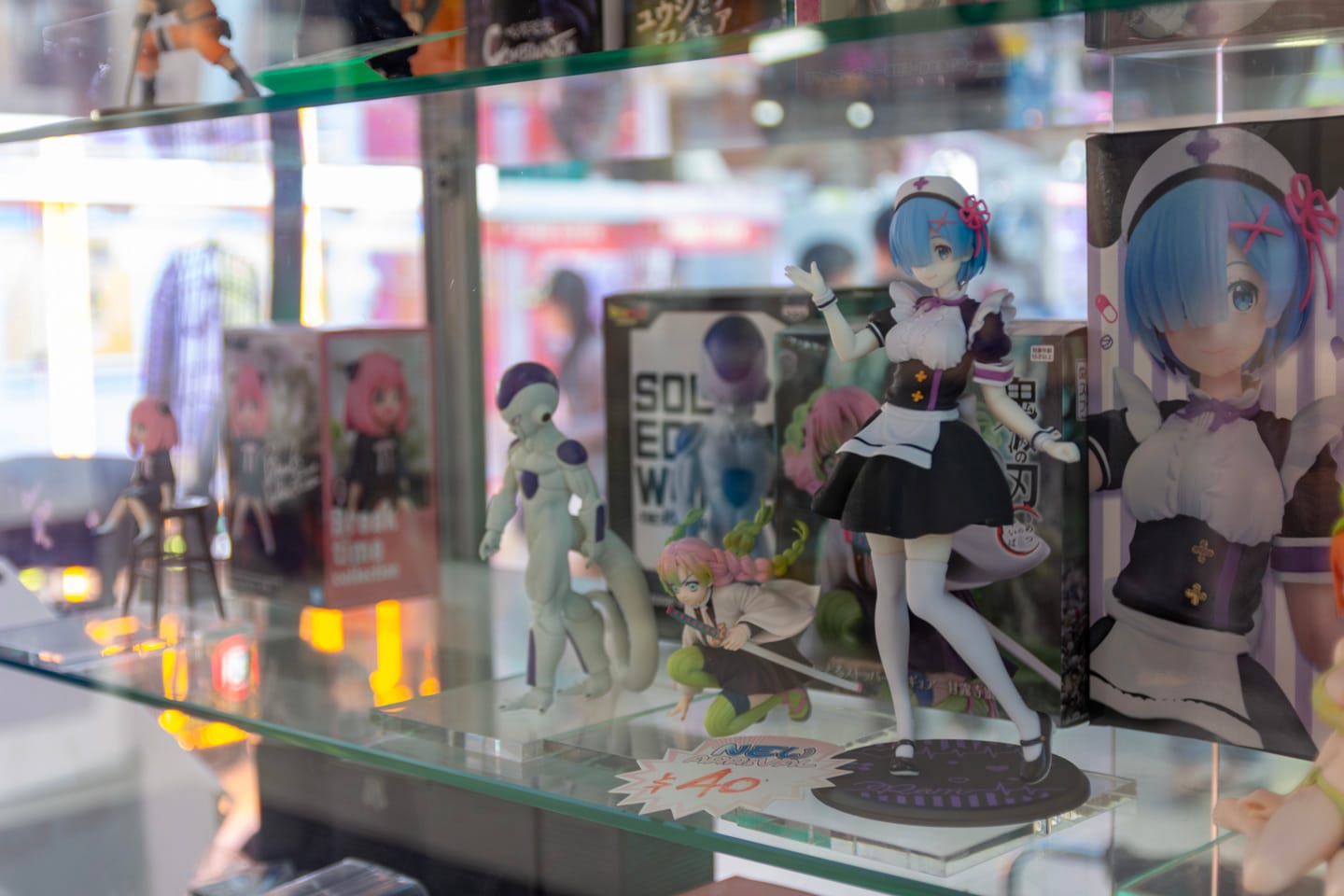
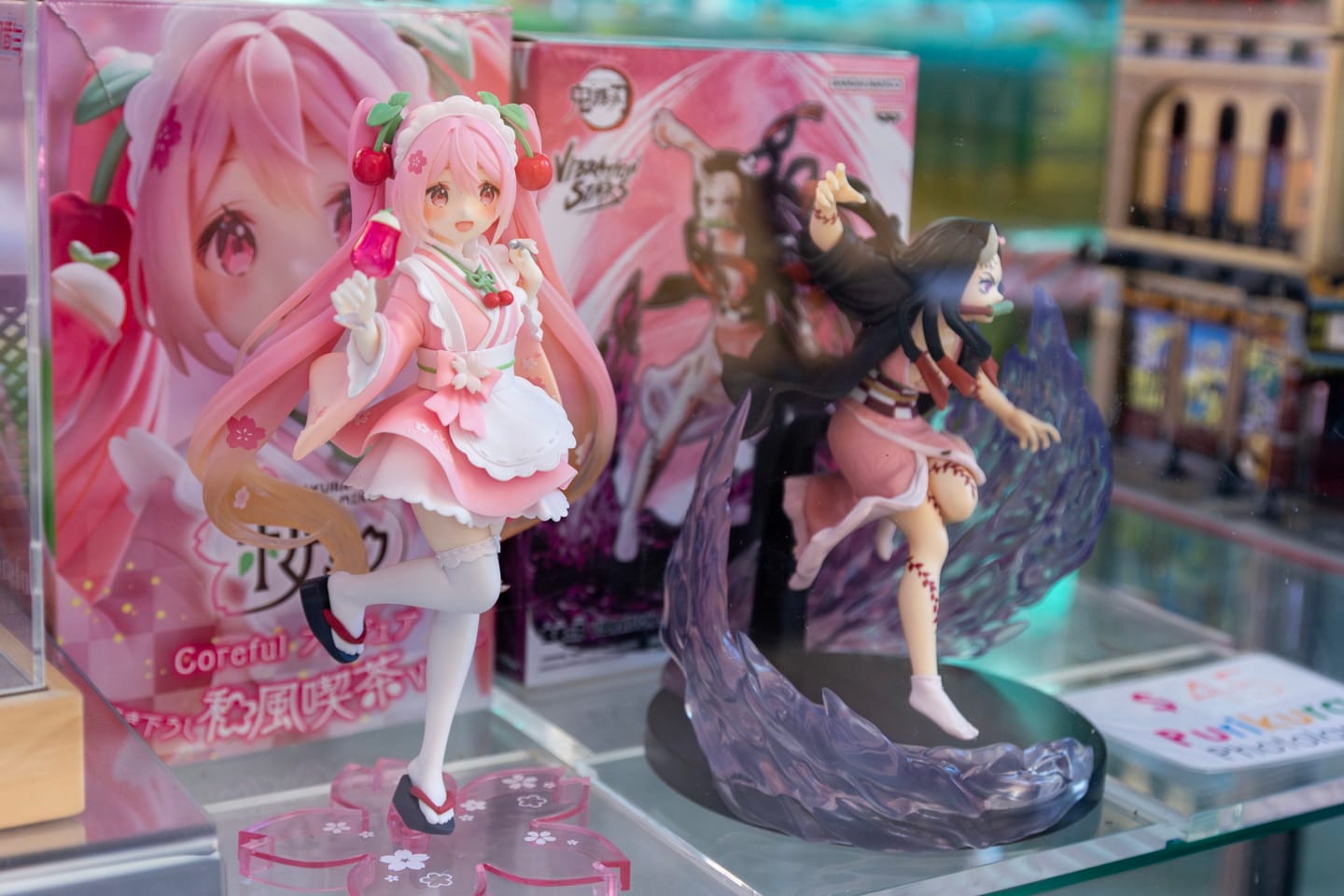
the shelf in question. judging by the sun bleached price tags, I’m preeetty confident every last one of them have been silently welcoming us in long before the cabs existed
Him having just finished a credit, we quickly got each other up to speed on what’s been happening since (“ehh… the same old, y’know”). Digging out whatever gold coins I had left in a fake Monster Beats by Dr Dre earphone case – my container of choice for spare change – he showed me the ropes, leading to what were my first two credits, ever:
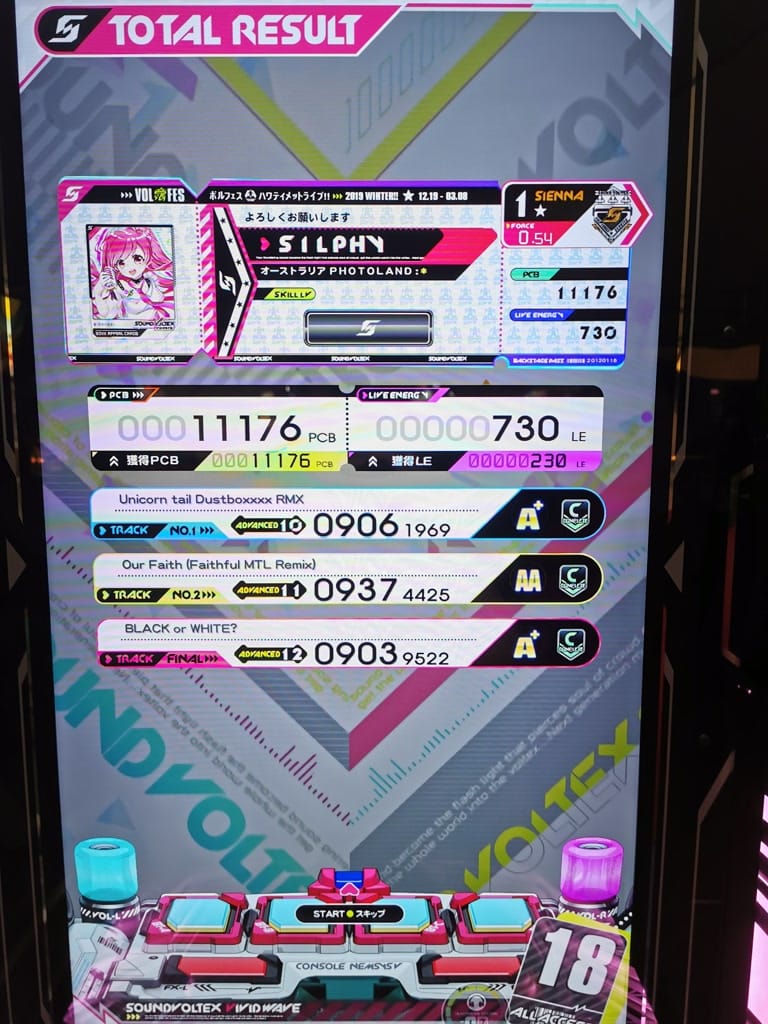
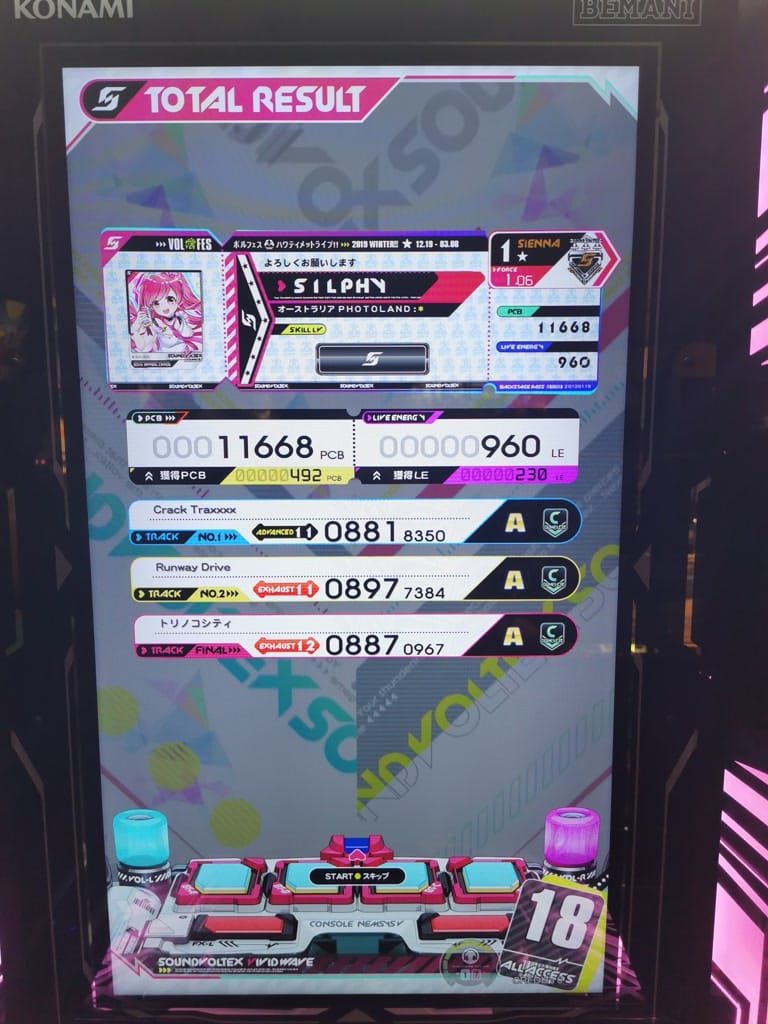
after watching crack traxxxx in jubeat, I sought to play it from where it actually came from
In ITG, I never thought to track my progress, so I never really knew how much and how fast my stamina grew over time. Whilst that was better late than never, SDVX was a totally new experience; I was keen on getting it right and making sure every last game was documented.
Over the next few weeks, I got into the flow of the process until it was second nature, which usually went something like this:
- Saying hi to the regulars when I arrive and sussing out the queue, establishing who’s before me and who’s after me.
- Exchanging a $20 note I got from the ATM earlier for some $1 and $2 coins.
- Ensuring my spreadsheet on the phone’s ready to note down what I’m playing.
- When it’s time for me to step up, tapping my save data card, entering my PIN, inserting two $1 coins, and earphones going in to the audio jack.
- Taking note of any daily missions before playing my turn of three or four songs.
- When complete, taking a photo of the results screen, just like the ones shown above.
- Packing up, sitting at one of the seats, entering any remaining details into my spreadsheet, and having a good chat with the others who were hanging around also waiting for their turn.
- Rinse and repeat.
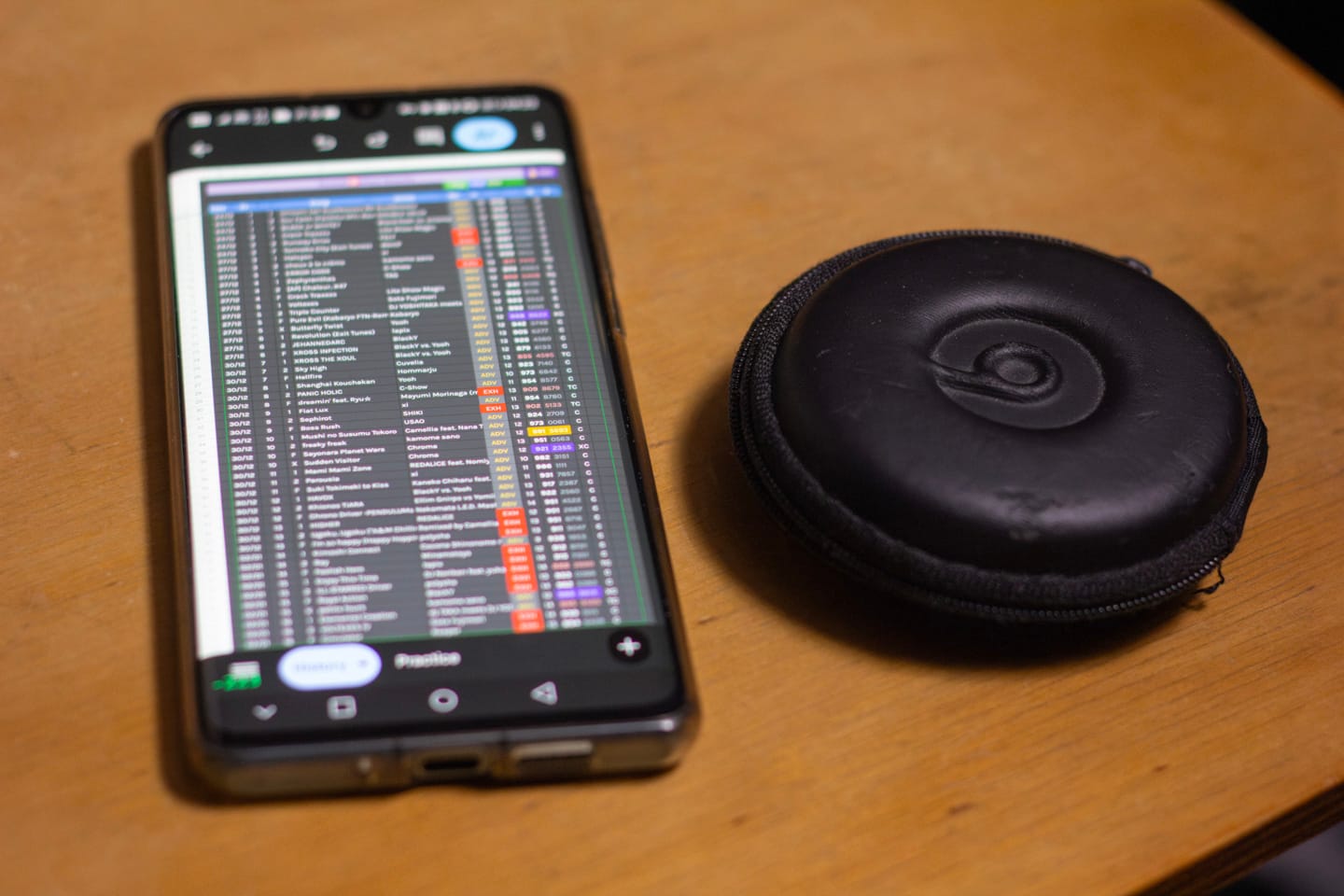
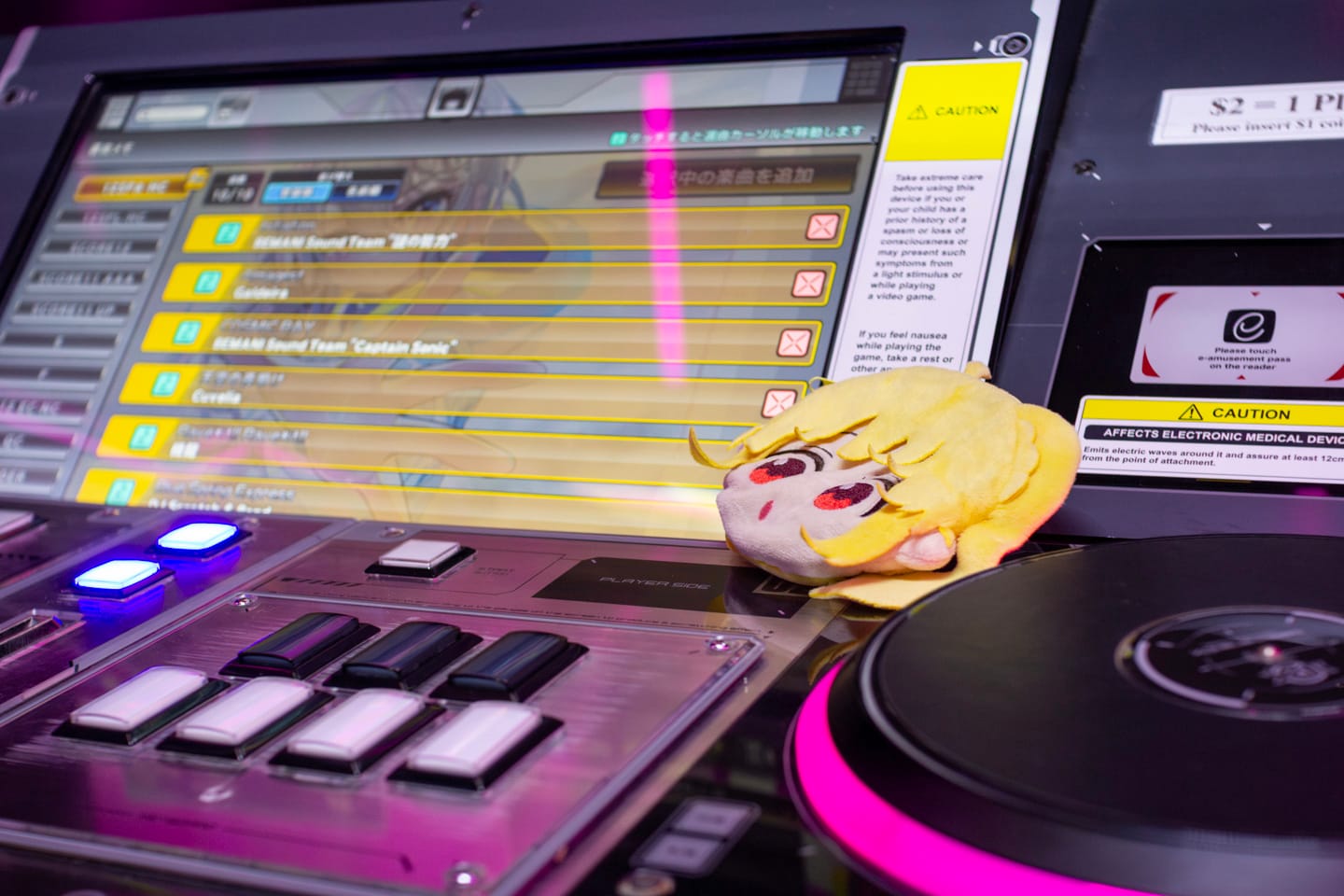
the nijika coin case would go so hard if puri had gitadora drums
Sure, the game was alright. But the most fun part was, of course, the hanging around bit.
Regulars: New & Reunited
In as little as a fortnight, I began to recognise the faces of regular visitors. Some of them were completely new to me, whilst others I’ve maybe seen once or twice near DDR at Market City. But given DDR was not their staple, “main” game, I’ve had very limited contact with them prior to Puri.
Thankfully, the limited contact was minimised through various group chats that spawned, spanning across multiple platforms as we saw fit. In there, there were a few more old names who came from Technika.
Who’d’ve thought? For many years, I figured everyone had moved on once the old scene died down – some old school players have since started a family, others moved overseas for their careers, some pick up completely different hobbies.
One of the occasional DDR visitors who were in the group chats turned out to be what one could consider the advocate of SDVX in Sydney. Of course, he wasn’t actively seeking to be that guy – and neither were any of us who stepped up to do whatever we did, like me with ITG tourneys. It was just how the chips fell.
Once I had become comfortable with the game and in a position to actually dive into the “real” content of SDVX, he had well noticed my progress and recommended I next check out a Google Sheet: a tier list of songs ordered by difficulty and skill set, meticulously curated by the Japanese community. This helped me immensely to get to the level where I’m currently at.
The Cheeky Lunch Break
A month into my experience with the game at the end of January, I noticed in one of our group chats he would post scores at Puri around noon.
…And it got me wondering.
At that time, I was working in an office within walking distance of Central Station in the northern part of Surry Hills, doing either 10:30 to 18:30, or 7:00 to 15:00.[9] Either way, I usually spent time after work fitting in a few games at Puri. Or, if time allowing, I’d trek with my workmates, who lived up north towards Town Hall, stopping by Event Cinemas to visit the then-rebranded iPlay George Street.
It was about a seven-ish minute jog from the office to Puri, accounting for the incredibly slow lift at my office. I gave myself about 45 minutes for lunch, so there and back left half an hour, enough for one leisurely paced game or two rushed ones. Totally possible.
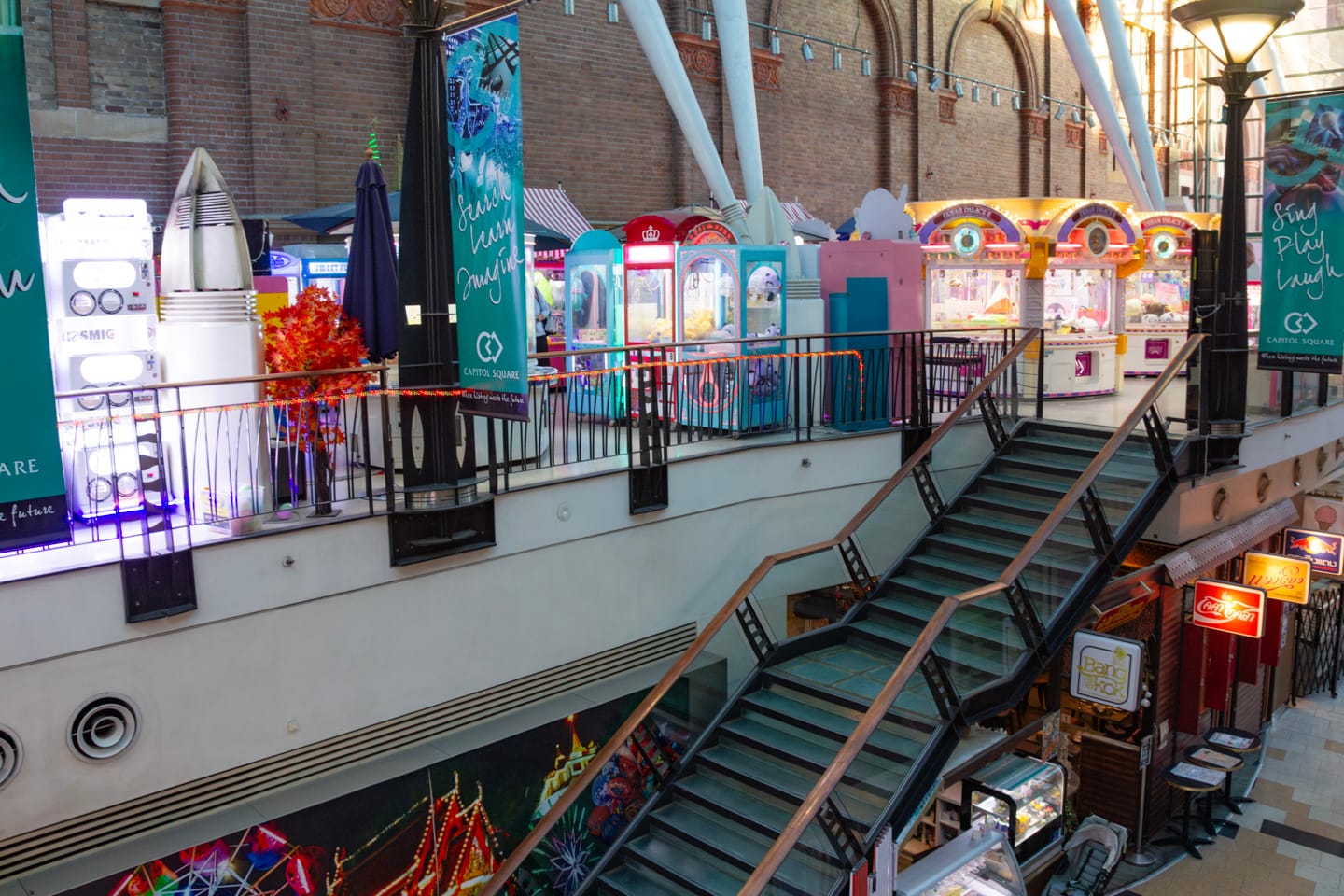
The strategy was to first go to @Bangkok downstairs (quite literally, as the above picture shows) for their lunchtime-priced meals, placing an order for a takeaway. Typically, that was the only order for the hour, so it’d take at most 15 minutes to prepare. Sometimes I’d tell them there’s no rush: patience and mindfulness makes for better food, after all.
Then, I’d come back up and do as most of the five daily tasks as I could, of which two or three could often be checked off in one game… unless the date was, say, 5 February.
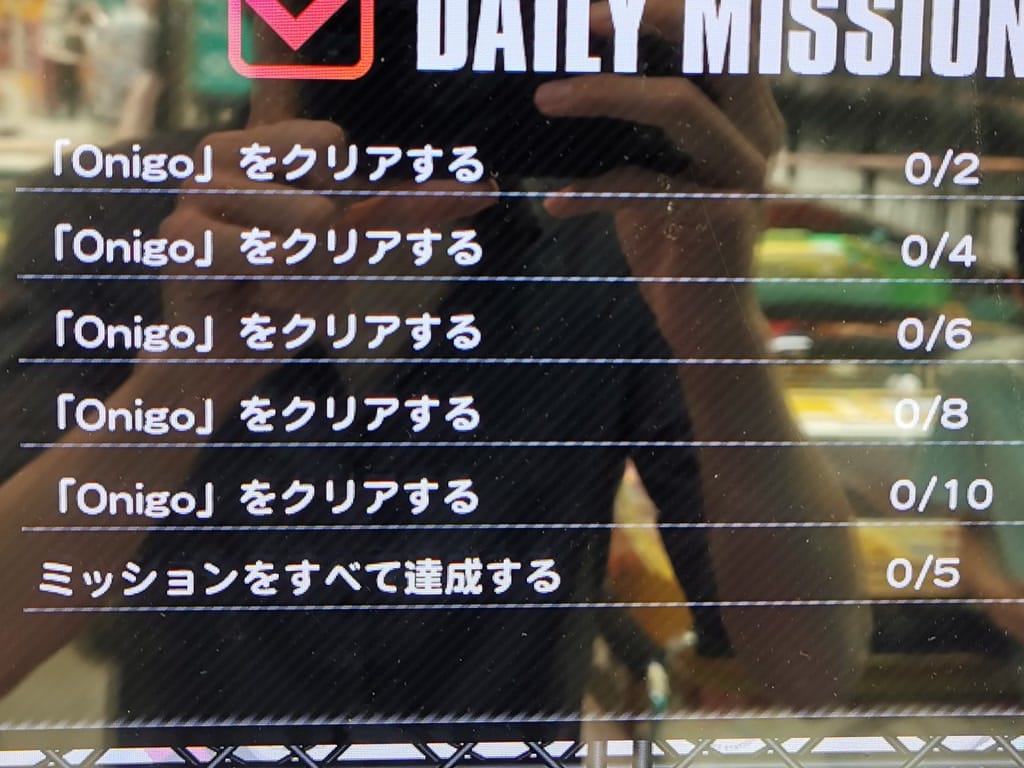
By the time I was done, I’d say bye to those who had just finished their song or credit (or wait a bit if they were nearly done), rush back down to pick up my long-ready meal, and exit out the light rail station side back onto Hay Street.
Jogging off to Puri at lunch to meet others for that short brief half an hour was a unique experience. It gave me a chance to cross the boundary (specifically, this was at the train underpass on the corner of Elizabeth Street and Hay Street) that helped split, but also reset my mind from, an otherwise uninterrupted eight-hour stream of work thoughts.
Unless I found myself another gig as close to an arcade like that, I don’t think I’ll have enough time to do such a thing again. Nowadays, I use my dance pad for actual work as a foot-controlled macro pad, so I’ve been having my ITG fixes instead at my office.
Unfortunately, none of us regulars were on the corporate grind back then, so there was a missed opportunity to show up to IIDX or SDVX in a business suit.[10]
Online Communities, and the Queue Check
In March 2021, our SDVX guy spun up a Discord server for Australians. A part of it was perhaps to be prepared in anticipation of Discord rolling out its community server features. But there definitely was enough of an interest in the game by then – not only in NSW, but also from across states, especially Victoria, despite them not actually getting their first cab up and running until April 2023. Before that time would come, their channel was titled something like #vic-waiting-room.
As there were more than one cab, players keeping track of where one was in a queue became complicated. To address that, Puri provided a whiteboard: players would write their name and shift highly DDR-reminiscent, arrow-shaped magnets around to specify who’s up next.
These whiteboards – there was a small and large one – were relatively public-facing; you could imagine how quickly it got out of hand keeping these under control for its intended purpose. As the small whiteboard seemed more than sufficient enough to do its job, the large whiteboard defaulted to becoming a free graffiti space for anyone to draw on. (I’ll admit I was a part of it, though I kept my contributions “relevant”.)
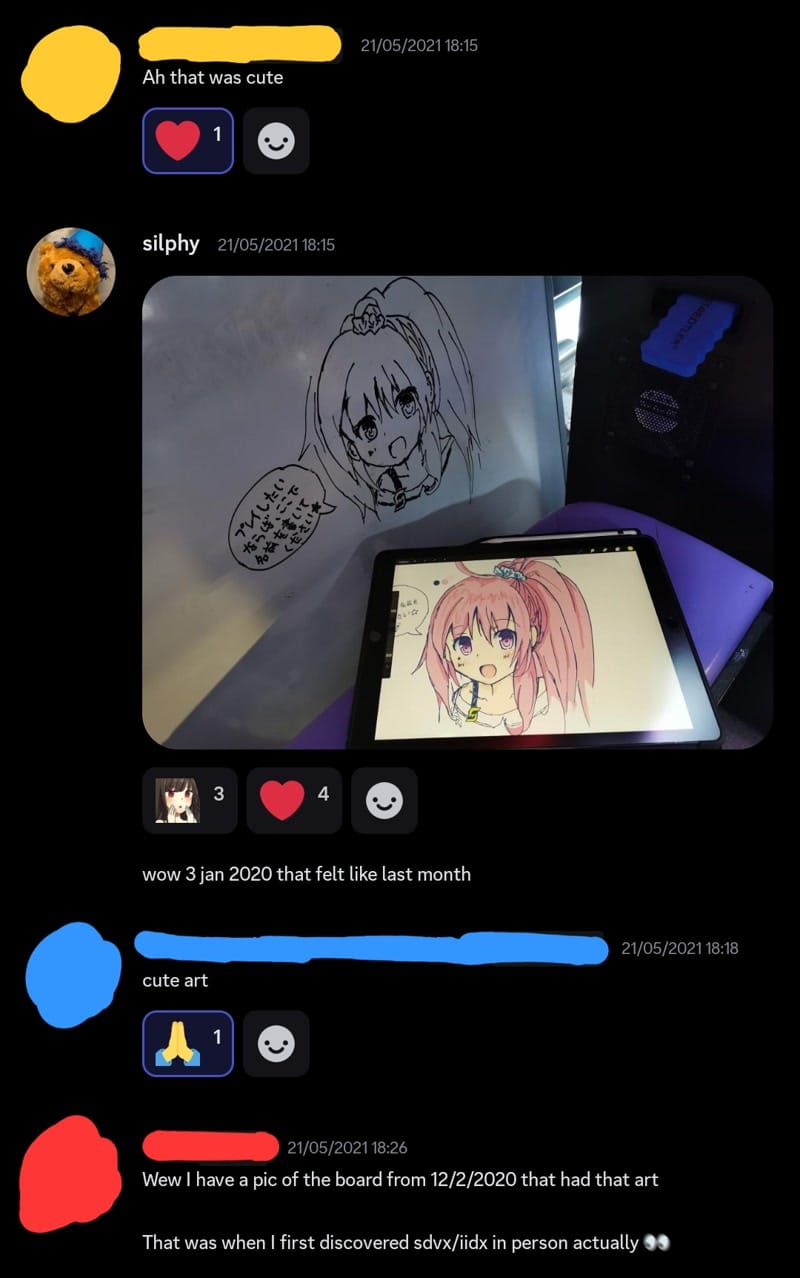
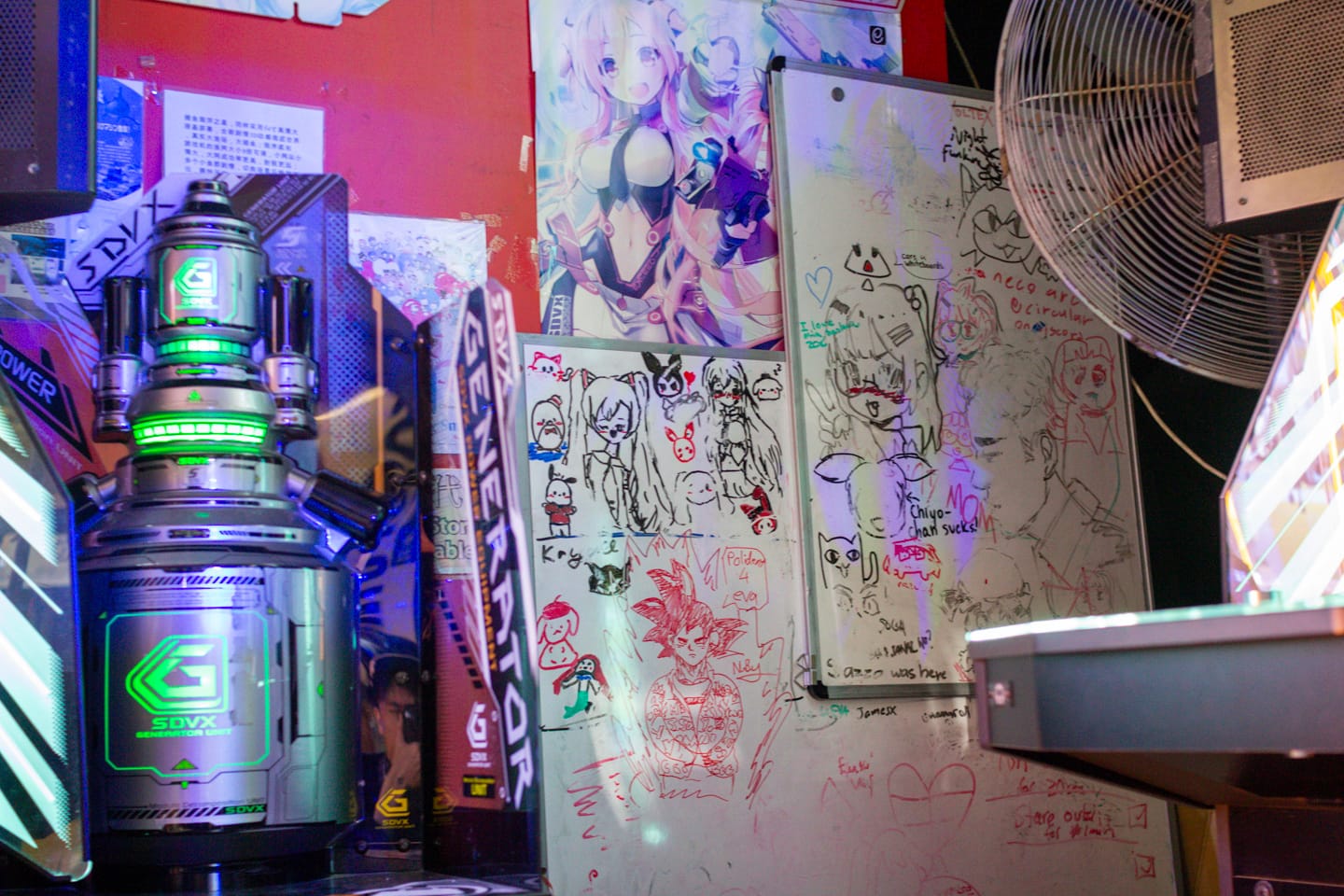
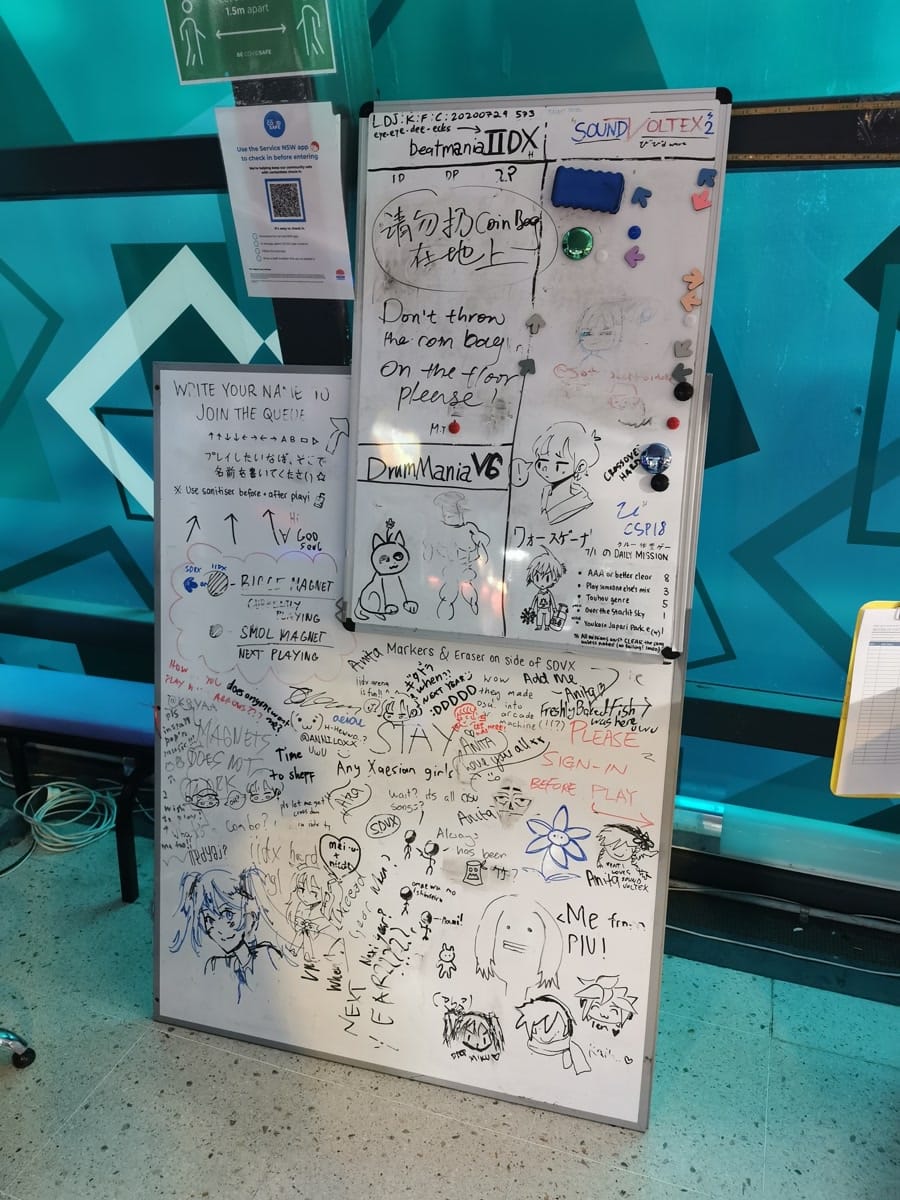
*ならば post purge • covid qpro was an invention I shamelessly over-recycled at conventions
Despite how messy it became (it went through two or three entire purges, maybe more), the board nevertheless contributed to playing a part in the aesthetic inelegance of the place.
Illustrations aside, a key feature of the server, much like any other arcade gaming community in general, was the good ol’ queue check channel: a wholly live, people-powered, request-response service, where one could ask qc <place>, and anybody who happened to be around said <place> would respond with a number, say, 4, representing the number of players currently in the queue.
After all, what a disappointment would it be if you showed up after an hour’s travel into town, only to realise the line was so long you could only fit in a game every 90 minutes? With the magic of qc, one did not even have to lift a foot to come to a decision. Did someone say puri 13 💀 just an hour ago? Welp, that’s a hard pass. Try coming tomorrow.
Yes, there were the standard channels of communication like score posting, art sharing (that’s me!) and feedback and advice channels; these were all staples of such a community. But for me, the most interesting, optimal, non-over-engineered concept that Just Works™ will always be the queue check.[11]
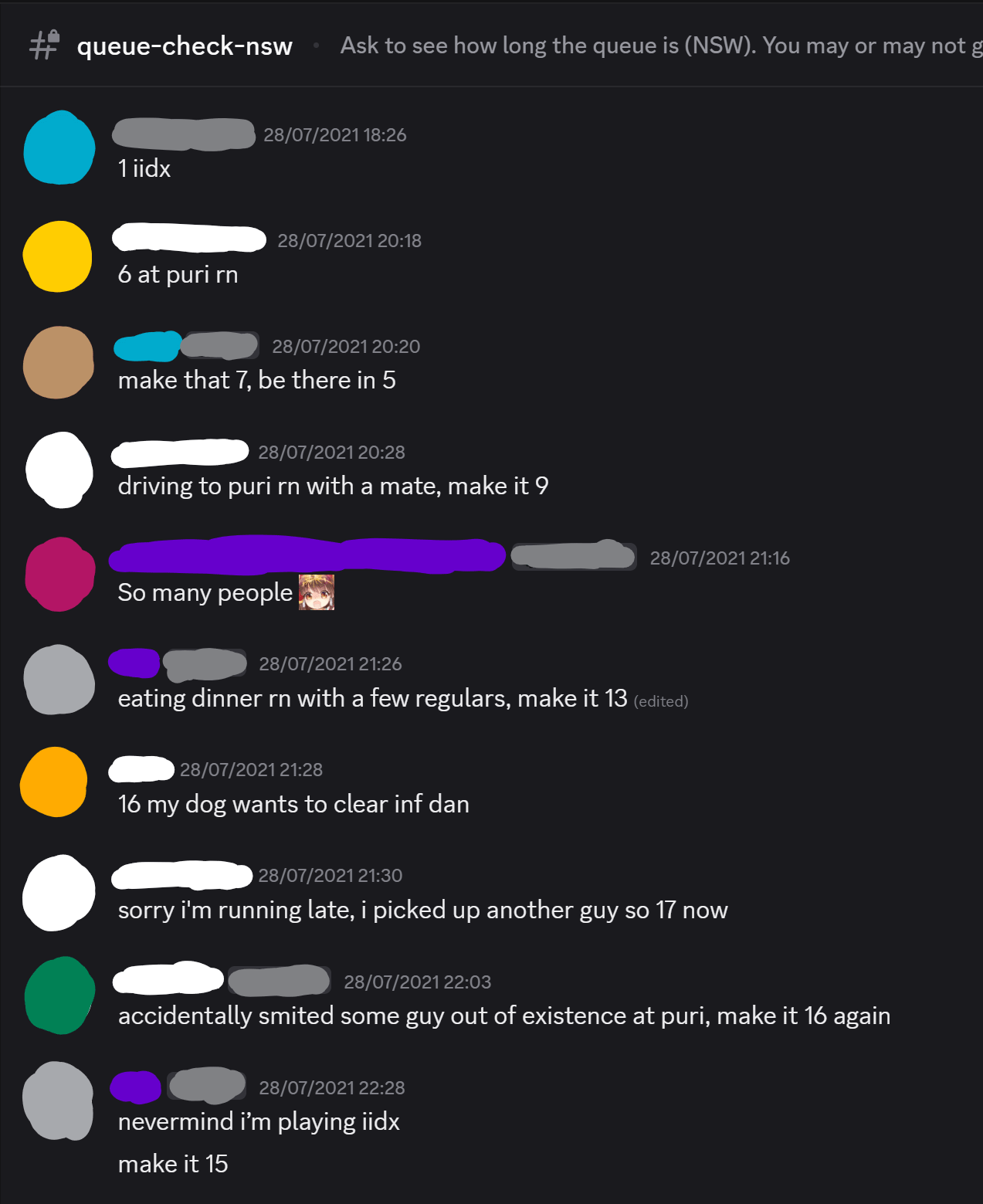
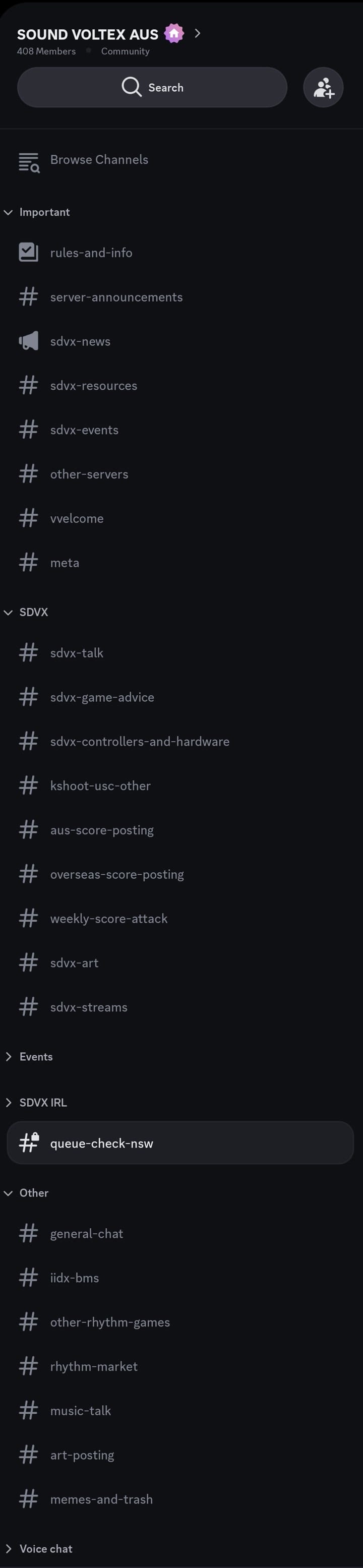
real talk, qc’s in excess of 8+ is rare, but well within possibility • there are other less-used channels not shown, but those are the main ones
Every time I bypass Puri from Central to Town Hall for any reason, I would go up the escalators and peek around the SDVX and IIDX corners, posting in the #queue-check-nsw channel my findings. Even if nobody asked for it, you never knew if somebody would appreciate the update. It was a small gesture, consuming little to no extra time, that I thought provided a much greater net positive value to the players.
•
But see, this server was a thing in 2021. Keen eyes and minds may have spotted that my whiteboard illustration was around the time I was playing SDVX at the start of 2020. What was I up to, then, in those several months? Playing more games?
History pop quiz time: do you recall something big happening in 2020? Something that was worth… staying at home for?
Yep, I’m talking about that.
That Flame, Only to Be (Mostly) Snuffed
The last row of data in my spreadsheet of progress was dated 17 February 2020, at which stage I had gotten to a pretty decent level. I also held that ITG tournament I mentioned just a few weeks before. It was chaotic but wonderful – and, looking back at it, also impeccably timed.
Because in the meantime, the world didn’t see coming that the Big C was poised, keen, and cooking to wreak some nasty havoc. By the start of April, various lockdown periods began and ended, and everyone had to put arcade gaming on a pause.[12]
When lockdowns finally eased for good a few years later, I’d long lost my momentum in SDVX. I had wrapped up work at the Surry Hills place during then, so there was very little incentive to visit the city. That time was spent instead at home focusing on personal projects (such as hosting further ITG events at SMASH!) and other contractual work to continue building my career.
Whilst I’ve played a few games at the occasional home arcade meetup every now and then to keep my SDVX muscle memory in check, I was well into my “casual player” arc.
But what I can say with absolute certainty was that SDVX was a game I’ve had the privilege to experience thanks to Puri and all the friends I’ve met there. It afforded new connections, which then led to even more newer ones, as this network of mutuals spread across different arcade games.
Rise and Fall
Admittedly, now looking back at it, my active time spent in SDVX was quite short, although highly focused. The rest of the events from then on I can only recall as a summary based off what I’ve heard of from friends in the chat groups I’m in, plus the rare moments that I’ve gone to visit Puri:
- In April 2021, a little bit more than a month after the Australian SDVX Discord server was established, the Puri correspondents and other friends managed to pull enough strings with the boss to get SDVX’s premium cabinet, Valkyrie Model, into Australia.[13]
- Other arcades were keen to follow in the years coming (more on how they compare in Part 3).
- Cabinets were abundant, and we were spoilt for choice.
- Queue checks were becoming unnecessary, as there was always a cab available; if not, one was never greater than a few places away from a turn. At one stage, I remarked on how the channel had managed to go without a message for a whole year.
- Puri missed, by a few days, getting IIDX’s premium cabinet set up by April Fool’s of 2023. Certainly a lost trolling opportunity.
- The most recent 2020 model of Taiko no Tatsujin also made a brief debut. However, other places, mostly Koko, were already the venue of choice for a lot of these players.
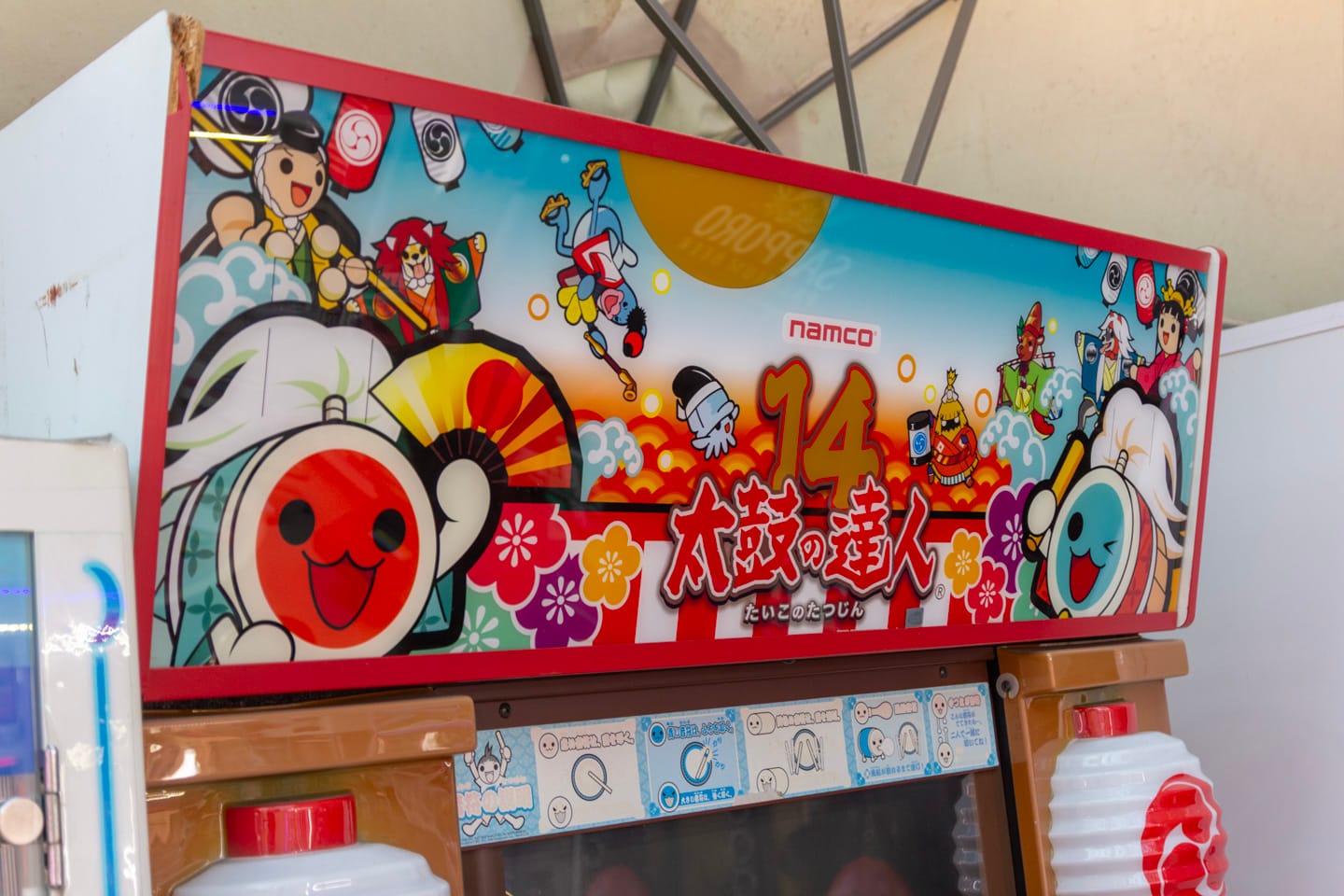
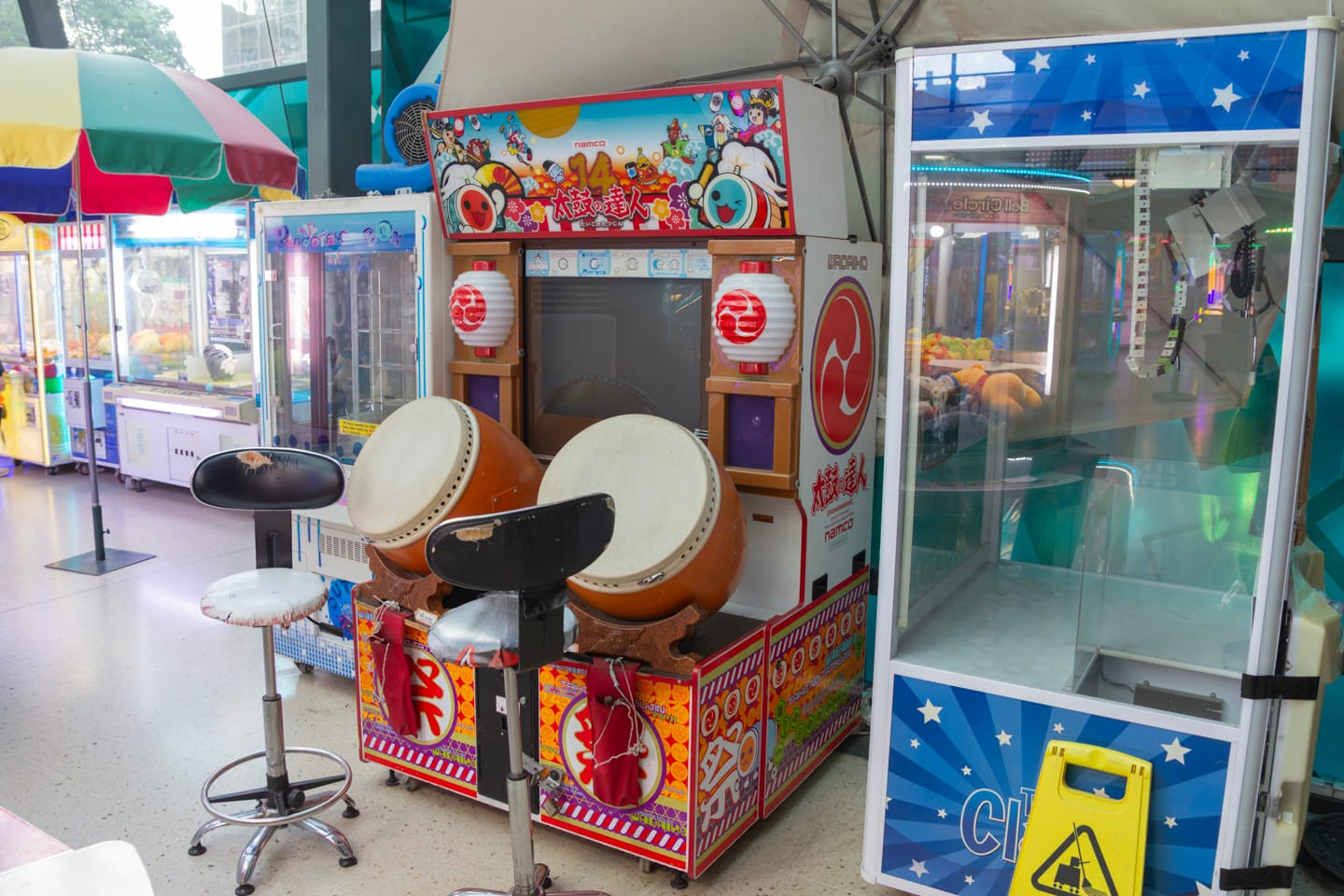
not the 2020 model, but japanese region cabs like this v14 are a rare find
Post-COVID, the total amount of money I’ve spent playing SDVX and IIDX could fit into that small coin case. I had hopeful thinking that some day I could find another job at an office in the city so playing these games with friends aligned with my commute.
But in a time when working from home switched from being an option to becoming mandatory because the business was wasting money on renting an office nobody could show up to, or simply that saving an hour each day from travelling was a huge plus, remote work has been seriously enticing. As of writing, my current office is in the opposite direction of city.
For someone who’s been around long enough to have witnessed “generations” of any community (or maybe not been around, but know second hand from friends), one thing is clear: people come and go.
At events or conventions, sometimes I might meet someone from years past. When asked if they still keep in touch with the crew of the yesteryear or if anything’s been happening since, usually the answer’s a “not really”, “not too sure, to be honest”, and maybe accompanied with a “IRL kinda moved me on”.[14]
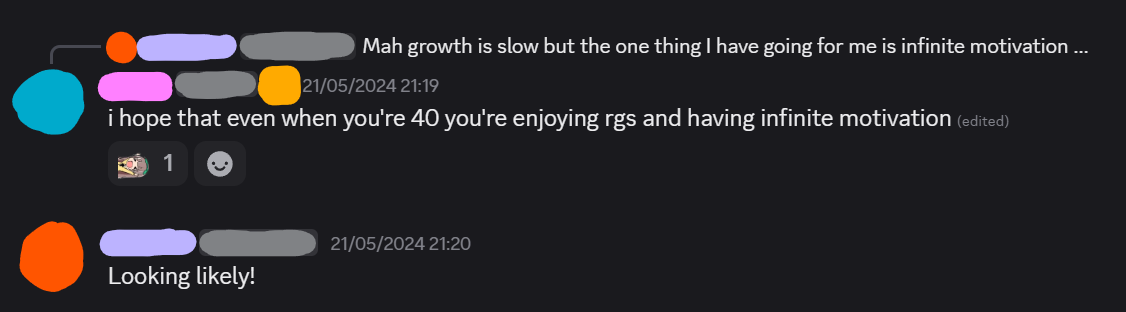
Indeed, life tugs at our necks and we’ve no choice but to eventually trudge along. It’s just some of us were the ones stubborn enough to have held on the longest.
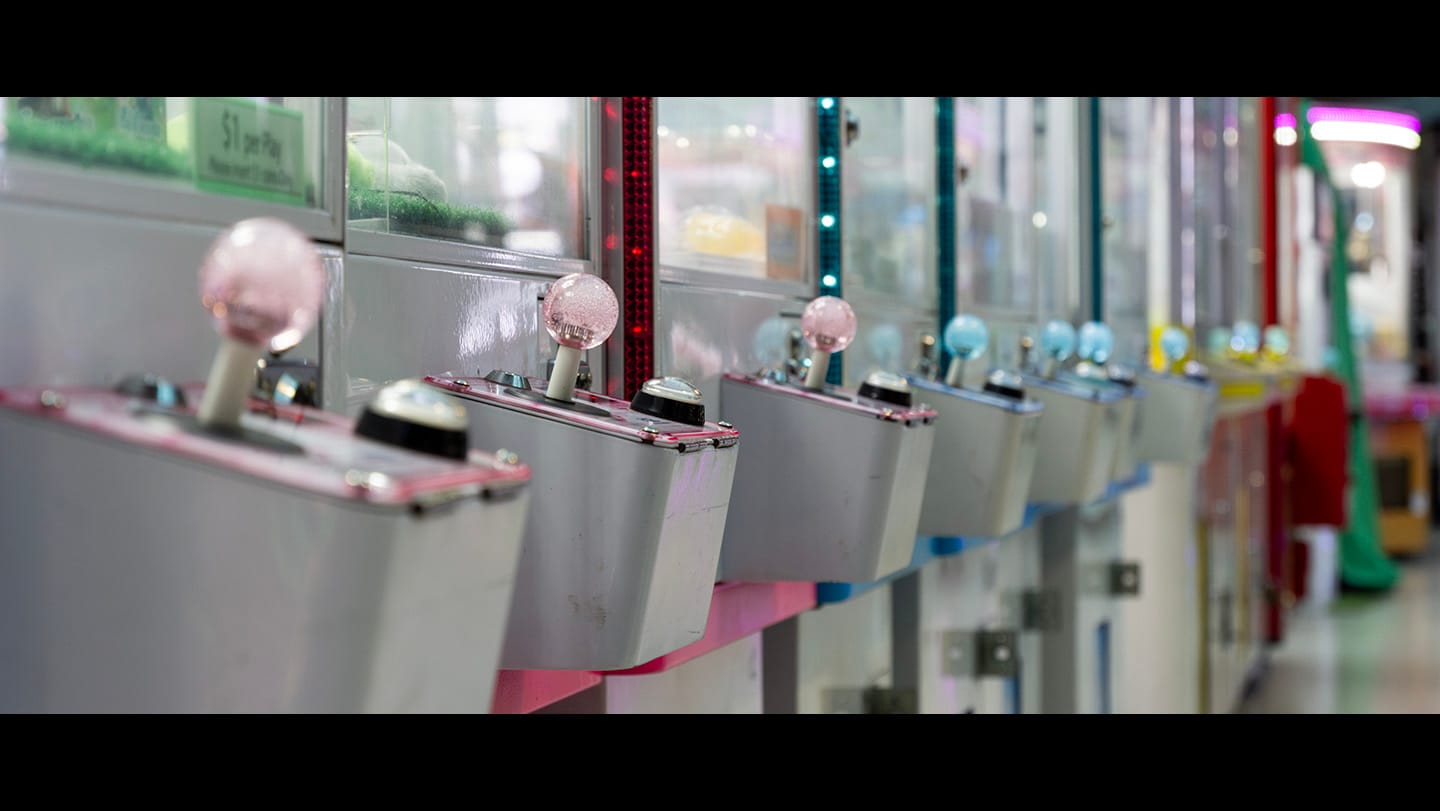
And when I say “people” come and go, I’m not just only talking about the players, of course…
A Final Meet
In the last days of June 2025, we organised what would be the IIDX crew’s final rhythm games meetup at Puri. And maybe also the final public gathering of this size for the foreseeable future, save outside of events and conventions like SMASH!.
The meet was less ‘organised’ and more of a ‘come if you’re around’ – but knowing this might be the last meetup with the fear of real life blindsiding us and forcing one to part ways, one might as well have treated this as time best set aside to show up.
In reality, the meetup was no different to any other gathering. We chatted about the game, what we’d be doing in the few to several months ahead, how I should finally get BMS up and running again so that I can stop having “meeting my yearly quota” as a continuing meme,[15] and what plans we had in mind about getting our gaming fixes after Puri’s gone.
Some of us were not keen, or in as easy of a position to be enticed, to go to Koko compared with Puri. Others considered taking things into their own hands, those ‘things’ being in the form of home controllers or entire cabinets themselves.
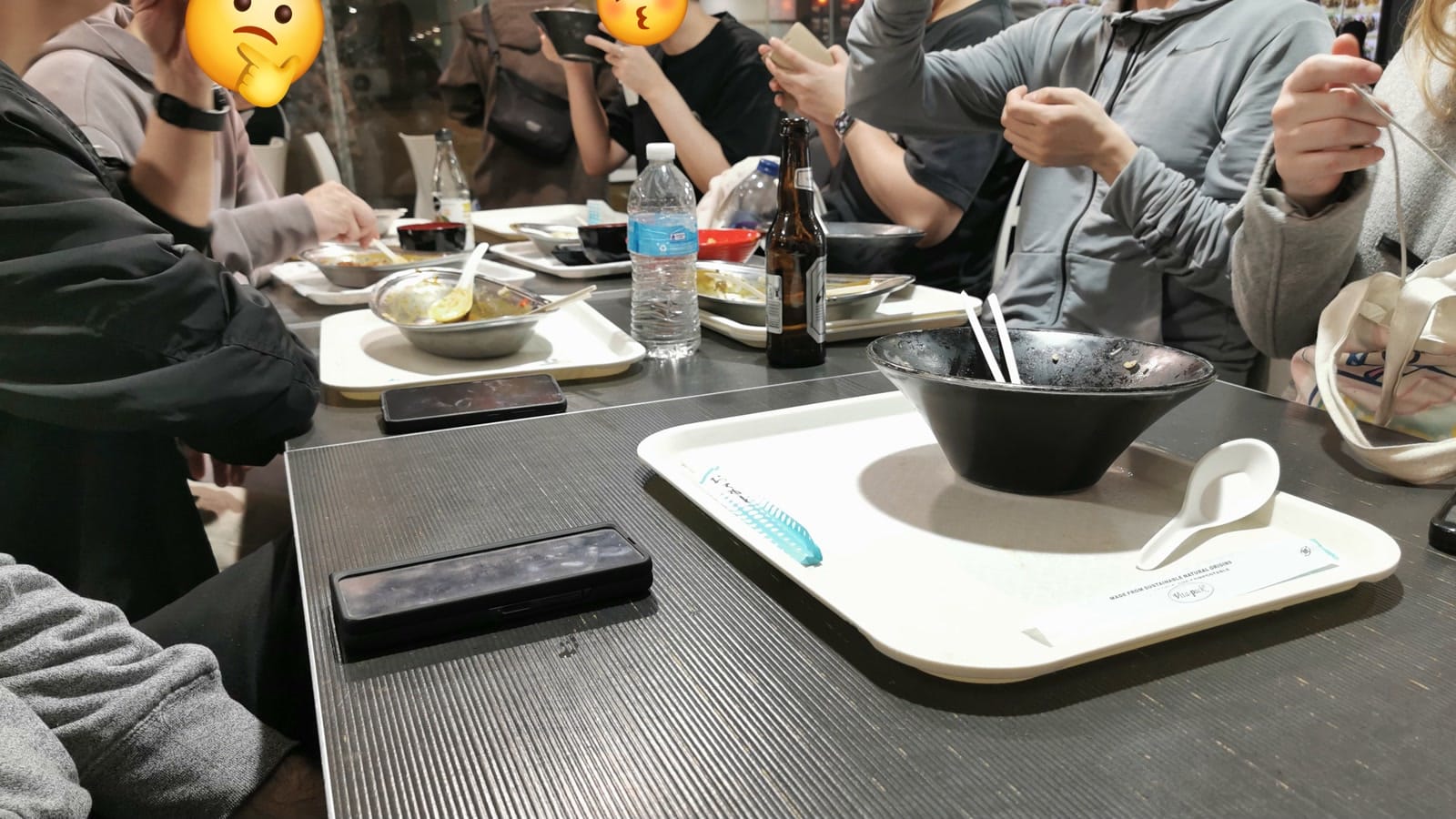
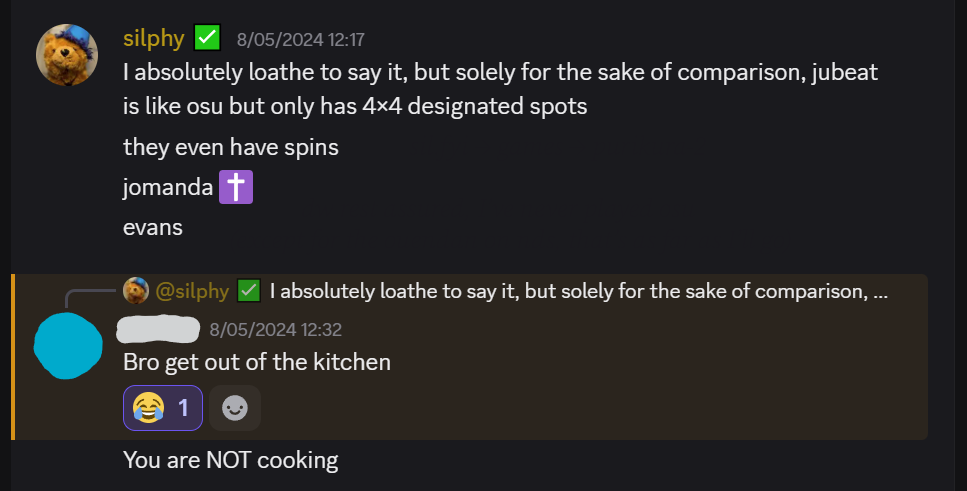
For a group in excess of ten, a relatively late dinner outside of Sussex Centre was going to be ambitious, so that place was the only viable choice. We had one guy (the one who evicted me from the kitchen for slandering jubeat) who had this unlucky streak of always showing up to Ken-Chan Curry when they’re unexpectedly closed. So you can imagine the delight he had when we peered our heads up over the escalators, ascending us into the food court floor as it came into view, to find the far left corner of the place still had their lights on.
Returning to Puri with a box of Emperor Puffs and peach bags of Molly Tea orders, we played our final credits of the only fitting song to play in this occasion, THANK YOU FOR PLAYING, and took final pictures of the cabs before they were gone from the venue for good.
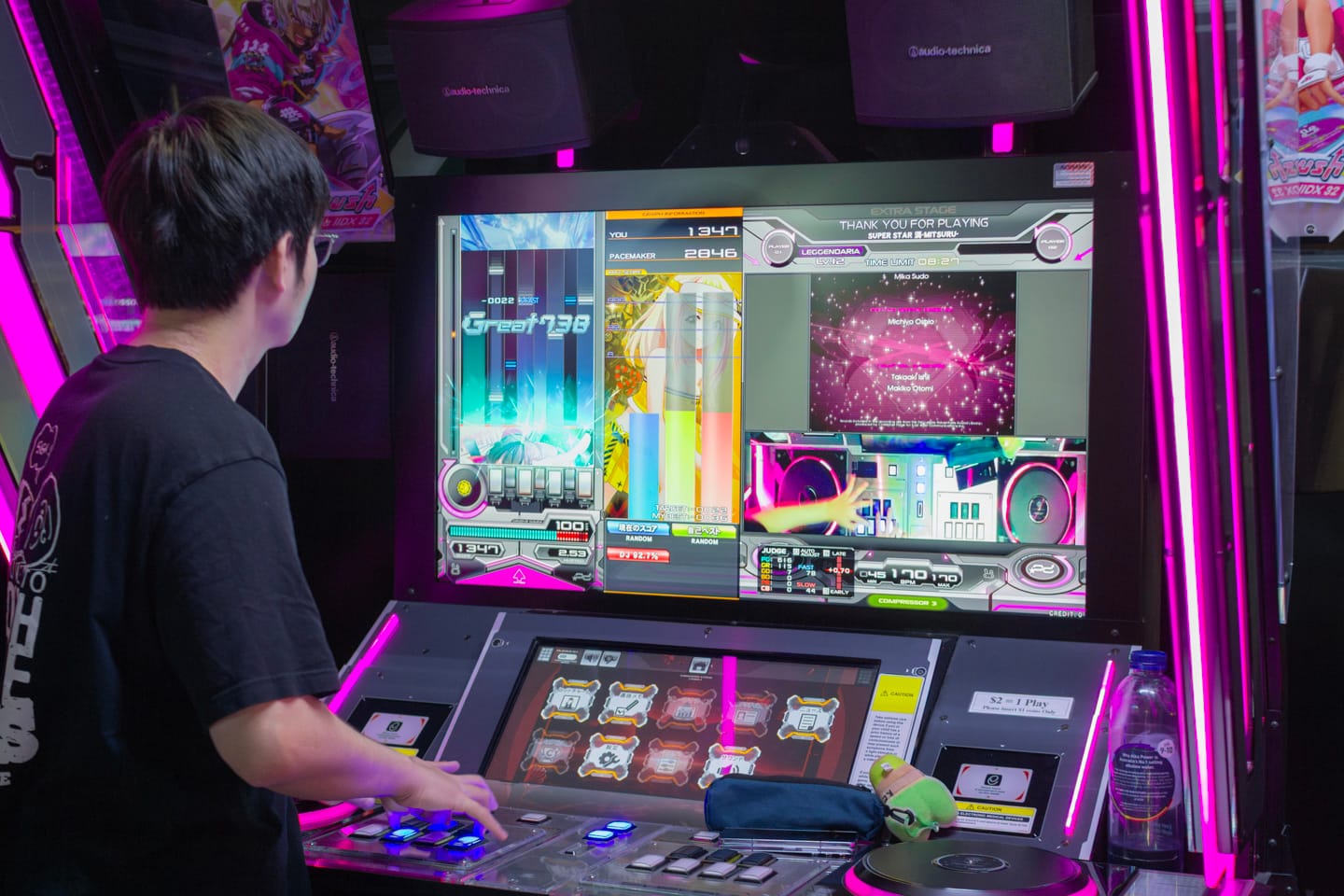
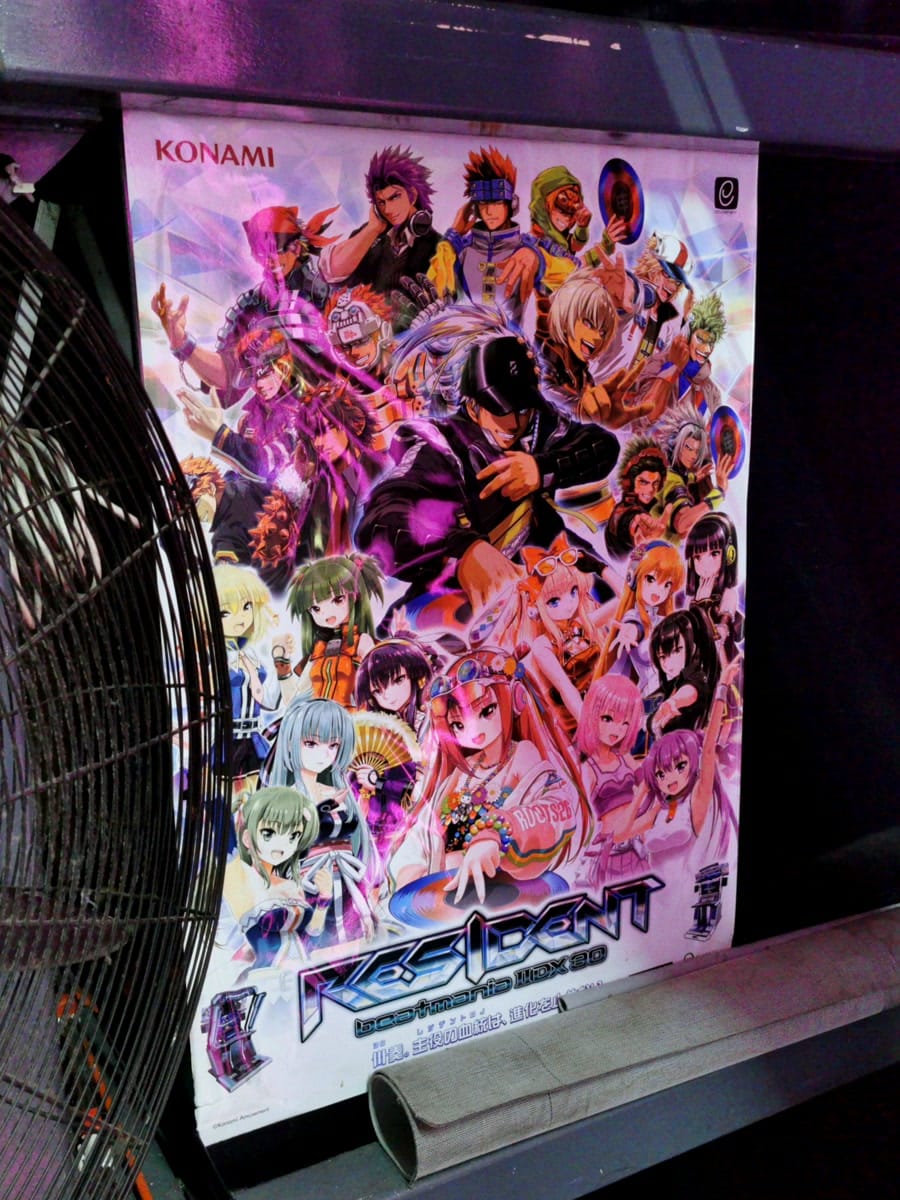
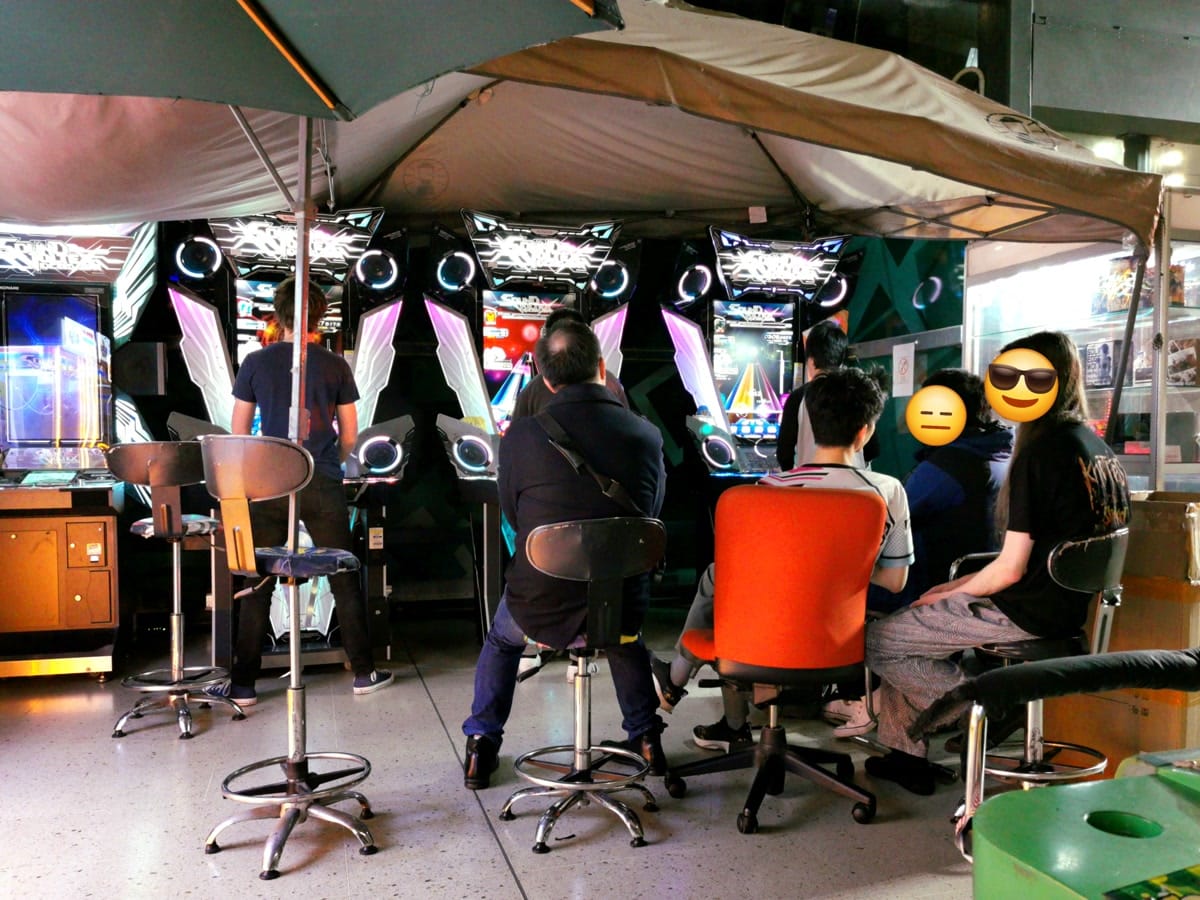
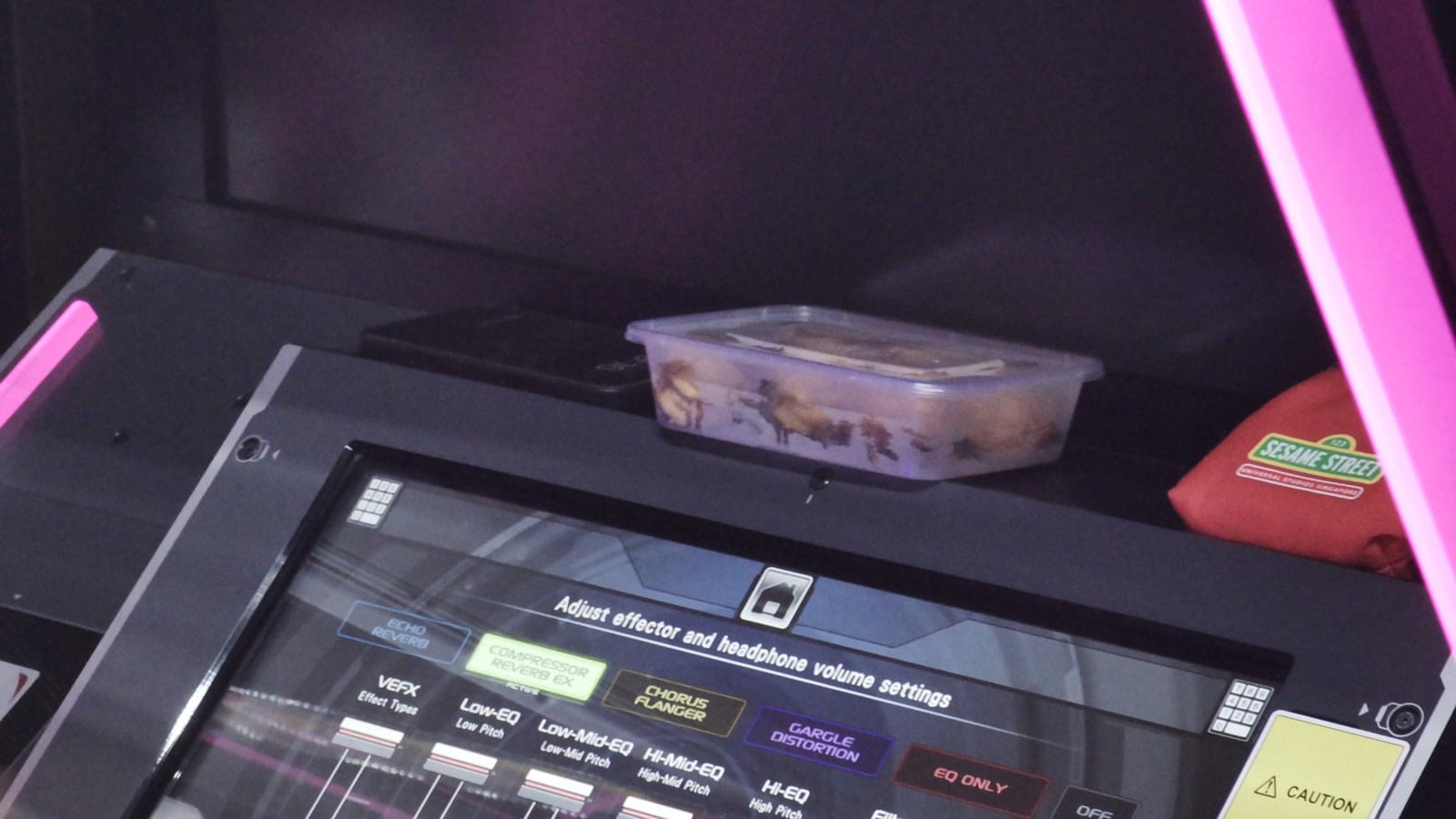
During this time, I’m reminded of the huge variety of games and origins of people whom I’ve met at gatherings like these, both private and public:
shout outs to the real ones
Firstly, the people I’ve mentioned here and in Part 1:
- The business starter. He got into the genre through playing Konami titles that were made for the iPad – just like me with jubeat! Analogous to Puri, he’s set the standard for bringing back modern rhythm games to Sydney (even Australian…?) conventions and events in the way they should be: if us regulars wouldn’t play on it, we wouldn’t host it.
- The SDVX rep who single-handedly brought us and the greater community together, shouldering the full responsibilities that come with it. I’m ever grateful for his help and support, to me and to all the other players.
- One of the twin brothers, excelling at doubles in IIDX, who makes music for BMS events. The other guy (holding the phone in the dinner pic) mains IIDX and Gitadora, always making good memes whenever an opportunity props up during his visits to Puri.
- Players from the past during DJMax Technika days. The one who guided me through my first credits now mains Taiko and the drums on Gitadora. Another old school player currently lives in Indonesia and frequently keeps in touch with us online.
And the others who are regulars to hangouts:
- An experienced PC gamer no stranger to Korean IPs (DJMax, EZ2ON, O2Jam, etc), now interstate for work. When there’s a reference to be had that warrants a sticker from one of these games, name it, and he’s always gotchu fam. :neowaz:
- There’s one who also plays these games, along with IIDX and SDVX, who is currently in the Philippines for a fair while. He’s helping build a community there via conventions and their own venues. We’re all excited for the day he can come back to Australia again.
- We have a few all-rounders whose skill levels or rapid growth in each game are mind-blowing. The one holding the bowl in the pic is studying for his PhD in China. Another is known for just being naturally good at every rhythm game due to his combined experience over time. A true example of
just play more. - All of the people I’ve briefly met, and some who I regularly catch up with, from maimai. A few players are DJs that are climbing the ranks; one of them, who plays for a friend’s birthday rave, was asked by the venue manager to perform for their own events! Another we met through a mutual friend about a year or two before he showed up in the group chat – call it a prophecy. Now we like to “bond over” (as his partner describes it) discussions about ways and hacks to beat the cost of living.
- Two second-level connections who each know their tech. One owns a variety of cabs, including Project DIVA (a rare find in Australia), and has a friendly, sassy cat. The other, with roots in IIDX, has her own server rack and a complete home entertainment setup definitely worth showing off. She, too, also has a talkative cat.
- Most of all, the one to bring all of us together. Her chat group “used to be dead”, but now could be said to be the backbone of these first and second levels of connections to everything else in the Sydney community. If there’s someone who knows everyone, it’s her.
There’s also friends of friends that I’ve either only met at meetups but haven’t had a chance to catch them outside of it, or just through seeing them as a tag along. One of the people who I’ve only seen once (at a much later time) gave me a really well-made Coreful figure of Maple from Bofuri for its price, for decluttering reasons.
Of course, there are many more people in the wider rhythm game community that have been around, like the DDR crew and the scarce remaining active ITG players, of whom I’m actually the closest to. The running gag we have with one of the top DDR accuracy players is that whenever he’d post a share-worthy perfect score, the group chat owner would respond with a “yeah, whatever.” He’d react to her message with a :doggorun:[GIF, 3.88 MB], follow it up with an “ok fine.” and we’d react to that with a :blushy: or a :heartslam:. If there’s one person who can get away with saying he’s shit, well… it’s also her.

The people I’ve mentioned here were directly related or adjacent to Puri. My sincere apologies if I’ve missed someone else – I’ve tried jogging my memory by going over any other forgotten names, but let me know if you slipped past regardless!
As rhythm games and its communities continue to grow online and offline – an environment I plan to contribute behind the scenes for some time (until IRL puts the final nail in my coffin, to which I’m honestly already half in at this stage) – I look forward to meeting not only new “generations” of players, but also new venues that might prop up.
But it is without a doubt that even if Puri arguably was the one to really put online rhythm games in its momentum, it’s only the combined efforts of all the arcades in the area that helped bring us to where we are today: Town Hall’s George Street proving the concept with Technika and DDR, Market City and the short-lived Fortress Sydney arcade area bringing competition and great value, and Koko providing the “player’s alternative” with a strong potential to rock the boat for arcade gamers despite visitors’ more ambivalent views.
the future is looking good.
[1] July 2012, because that’s when the EVOLVED nonstop course was available to play during its two and half or so weeks it was open. It’s a story in and of itself, but at the time it was mindblowing to me to have been able to experience fresh, live content, with impossibly strict requirements (for my skill level at the time) made lenient. There would’ve been an incredibly small audience who had attempted that course in Japan, and so for those in Australia, the players were perhaps even countable on one hand.
Its timing was impeccable; the router that kept the cab online had gone kaput for good the week after.
[2] jubeat was kind of a hard one, presumably due to regional restrictions. Most Konami games have warnings that state certain titles aren’t allowed to be played in certain countries. Although prop did have a version that allowed games to be played in the Asia region (which would include Australia in this case), I believe we were playing on the Japan region version. Don’t quote me on this, though.
[3] (2022, February 22). George Street was March […] Canberra was May. Discord.
[4] This guy has consistently shared his beatmania IIDX score posts to our group chat that was, in a way, a diary of his growth. IIDX was another online rhythm game that Puri has taken the first-in-Sydney cake for, and one can see why he has a high investment in it. Both him and the twins are super chill mates.
[5] Timezone have previously marketed on social media the fact that they are the exclusive franchise to provide DDR’s premium gold cabinets. That should hint to you the level of competition places here are dealing with.
[6] National anthems as song choices could be best described as a halfway point between “stereotypes” or “clichés” (but slightly less derogatory) and “safe choices” (but doesn’t exactly capture the essence of the term). Perhaps a somewhat weak analogy is like what people think of first when they think of an alcoholic drink: maybe Hennessy if cognac, Johnnie Walker if whiskey.
[7] Speaking of coin exchange machines, it reminds me of the days when prize redemption tickets used to be linked physical cardboard coupons instead of digital currency. Market City had these purple Ticket Eater machines, the one with a Pac-Man-like typeface, that counted on a 7-segment LED display the number of tickets you fed into the roller, printing its number on a receipt when you hit done. If there was a contender for highest disgrace to the environment, this would be up there.
[8] Timers Re:venG was my second iteration at an ITG tournament series focusing on closing the immensely wide skill range that comes with this game. To do that, I wove in a card game as the RNG/strategic twist. Like any other tournament, it was less about the competition itself and more about just having an excuse to hang out with people who share the same hobby of dance gaming.
This meetup had an anticipated incredible variety of visitors, hailing from places closer to home like Queensland, to as international as the United States and Russia. So the stakes were high!
[9] These odd hours were a huge perk, working in a position of trust where getting the work done was far more important than when it was done. I was a discount fiend, so if public transport offered 30% off fares for travelling outside of peak hours, it was absurd to not take advantage of it.
[10] That idea hasn’t been lost in Japan, and neither here; one of my earlier ITG tournaments held at the end of the financial year, aptly named EO[FYT], had formal business as the dress code.
[11] A whiteboard to indicate a queue is still a manual process. Now, if that made you think, “Can’t this thing be automated?” we’ve been there, done that, brainstorming about how a clean digital solution/app would work. But it creates a few assumptions, including but not limited to, that everyone:
- Owns a smartphone (that’s got enough battery to be on)
- …that has mobile data
- …that’s modern enough to run the solution
- Knows how the queuing system works and abides by it
- Doesn’t need to jump through hoops for one-off players
Addressing and enforcing people to use this system inevitably causes unnecessarily high friction (emphasis one-off players). Besides, this alone is going well into the range of overengineering. That’s what I mean by the term; anybody can use a whiteboard, and people can keep in their minds when one-off players hop on in the queue.
[12] Unfortunately, these sets of COVID pauses destroyed most of the Sydney ITG player base at the time. It was a good stopping point for those of us who’ve decided to move on with life, be it the real kind or the gaming kind. A few players gained interest in maimai instead; one of them grew insanely good at it to the point where he eventually became the Sydney advocate for that game.
[13] Premium cabinets like SDVX’s Valkyrie Model and IIDX’s Lightning Model generally provided a fancier, QOL gaming experience. Think larger, 120 Hz screens (instead of the standard 60), touch screens, and exclusive content.
The introduction of Valkyrie Model aligns with the sixth major update of the game. The pink, colourful theme in the results screens seen above was the previous fifth version. By the time COVID had passed, the blue colour palette and “professional” UI design of this sixth version was completely new to me, and relearning the game again was by that stage several items down on my ever growing “things to get to in my spare time” list.
Now, in 2026, where the seventh major update was released, the Valkyrie Model is the standard. Konami is phasing out the regular models from service, so this seventh version marked the proper end of support for that model.
[14] At SMASH! a few years back, I chanced upon an old school player who had long moved on from the arcade scene. He’s since found a new community of friends in the virtual YouTuber space, and I was pleased to hear he’s been doing great. Perhaps unfortunately, conventions are looking to be the only practical time we will ever meet up. But in a way, despite once a year feeling so infrequent, it seemed oddly sufficient.
[15] Like with SDVX, albeit to a less detailed extent, I keep track of key achievements with my BMS sessions in Google Keep. The only problem is that since August 2021 when I first (and last) played, clocking in at a total of three hours gameplay time, I haven’t booted up lr2oraja and played more than one song for the purposes of making sure updating it didn’t break anything.
It’s just coincidentally when I do remember to update, it always seems to be around the time of August. Presumably, I figure this is because it’s after SMASH!, the first time I’m free for the year. And thus, that’s why it’s established that August would be my month of 7 key gaming… if I wasn’t already preoccupied processing photos and drafting my post-event retrospective!
make it make money